
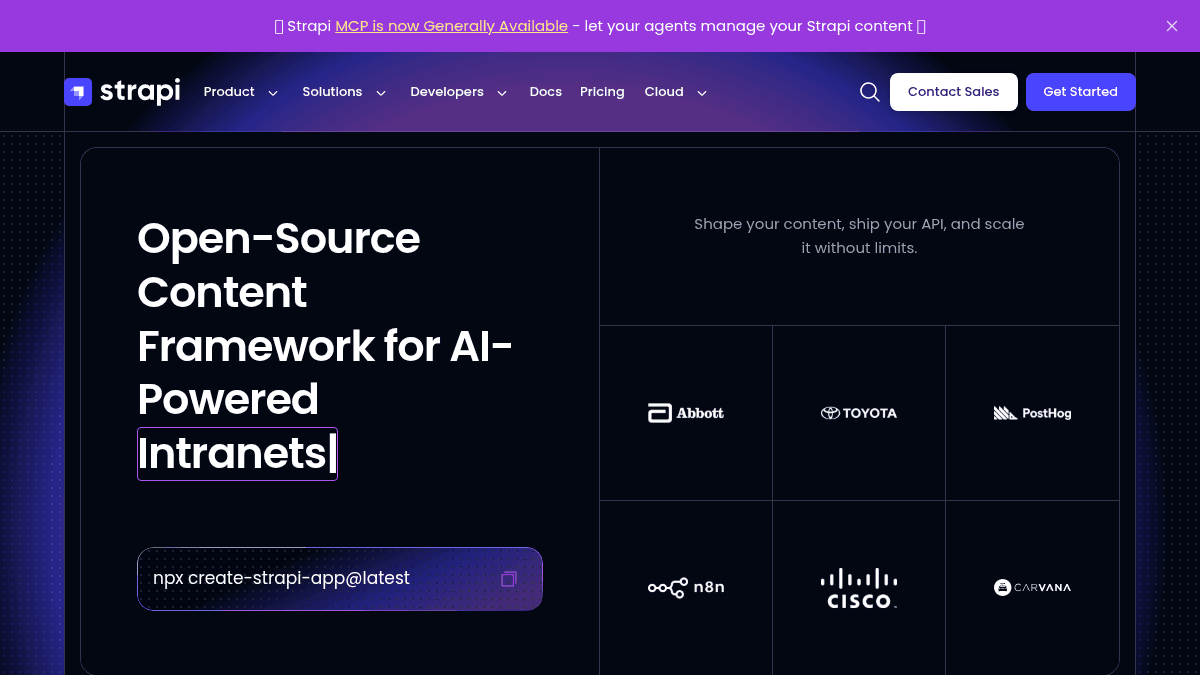
About Strapi
Overview Strapi is an open-source TypeScript headless CMS that gives developers a content framework rather than a locked-in platform. Teams design content types, components, and dynamic zones in a no-code builder, and Strapi instantly generates REST and GraphQL APIs with full typing. It is built for developers who want full control over their content stack while giving editors an admin panel they can actually use. Unlike proprietary headless CMSs that rent data and limit customization, Strapi is MIT-licensed, self-hostable, and runs as a real Node.js application. Developers write custom controllers, services, and middleware on the backend, reshape the admin panel on the front, and deploy anywhere — their own servers or Strapi Cloud. It is SOC 2 certified, GDPR compliant, and trusted by over 3,000 customers including Airbus and Tesco. Key Benefits Content models become fully typed REST and GraphQL APIs in minutes using a drag-and-drop Content Type Builder. Editors rearrange page structure freely with Components and Dynamic Zones, reducing developer involvement for content updates. Strapi runs as a real Node.js application, meaning developers can write custom controllers, services, and middleware instead of being limited to plugin surfaces. Self-host on any infrastructure for full data residency and compliance, or deploy to Strapi Cloud with Postgres, CDN, and email included. Strapi Cloud offers three tiers — Starter ($35/mo), Pro ($90/mo), and Business ($450/mo) — with API request limits from 100k to 10M per month and asset storage from 50 GB to 1,000 GB. Community of thousands of developers contributes plugins and integrations through the Marketplace, reducing work already done by others. How It Works A developer runs npx create-strapi-app@latest to scaffold a new Strapi project. Inside the admin panel, they use the Content Type Builder to design models, add Components and Dynamic Zones, and attach Custom Fields without writing schema files. Strapi automatically generates the corresponding REST endpoints and GraphQL queries, all fully typed. The team then deploys the project by pushing the GitHub repo to Strapi Cloud or hosting it on their own infrastructure. Use Cases Frontend developers at digital agencies use Strapi as a backend-agnostic content API that works with Next.js, Nuxt.js, Astro, Svelte, Vue.js, React Native, or TanStack. Enterprise marketing teams at organizations like Airbus consolidate multiple disconnected platforms into a single content source, reducing webmastering costs and scaling inconsistent web pages. Engineering teams building ecommerce platforms or product information systems need a customizable CMS that fits their existing architecture rather than forcing a predefined content model. Developers creating AI-powered applications or agent-based workflows use Strapi's new MCP integration to let AI agents manage and retrieve content programmatically. Learning management system and intranet CMS builders need a self-hosted, auditable content layer that meets GDPR and SOC 2 compliance requirements out of the box. Open-source projects and non-profit organizations qualify for discounted Strapi Cloud hosting, making the CMS accessible for mission-driven work with limited budget. Why Choose This Product Strapi is best suited for development teams that need full control over their content architecture — from model design to deployment — without sacrificing the editorial experience of a traditional CMS. The self-hosted option makes it a strong fit for compliance-heavy enterprises, while Strapi Cloud simplifies operations for teams that prefer managed infrastructure. Limitations include API request caps on Cloud plans and no built-in multi-environment branching.
Strapi Pros & Cons
- Open source under MIT license — full code ownership
- Content Type Builder generates REST and GraphQL APIs instantly
- SOC 2 certified and GDPR compliant
- Self-hostable or managed cloud deployment
- Rich plugin marketplace with community contributions
- No self-hosted free tier on Cloud plans
- Starter plan caps at 100k API requests/month
- No dedicated environment per branch
- Strapi only — not a full platform
Key Features
Content Type Builder
Drag-and-drop interface to design content types, components, and dynamic zones without writing schema files.
Components and Dynamic Zones
Editors can rearrange reusable content blocks on a page without requiring developer intervention for layout changes.
Custom Fields
Add any field type needed, including custom validation and data structures not covered by default field types.
Backend Extensibility
Write custom backend controllers, services, and middleware, and reshape the admin panel — all while keeping the speed of a standard CMS.
Auto-generated REST and GraphQL APIs
The built-in no-code builder automatically generates fully typed REST endpoints and GraphQL queries from your content model.
Plugin Marketplace
Browse and install reviewed plugins and integrations from the Community Marketplace, or build and publish your own.
Strapi Cloud and Self-hosting
Deploy to Strapi Cloud with a managed Postgres database, global CDN, and built-in email provider, or self-host on any infrastructure.
Enterprise Compliance
Strapi is SOC 2 certified and GDPR compliant, with audit logs, review workflows, content history, and SSO included.
AI Agent Integration
Already supported via the new Strapi MCP integration, letting AI agents manage and retrieve Strapi content programmatically.
Multi-environment (Cloud)
Duplicate production data into a safe environment, preview changes, and test content before going live.
Strapi Pricing
View full pricing →- 100k API requests per month
- 50 GB asset storage
- 50 GB asset bandwidth
- Unlimited database entries
- Built-in email provider
- Fast and global CDN
- Custom domains
- 1M API requests per month
- 250 GB asset storage
- 500 GB asset bandwidth
- Unlimited database entries
- Multi-environment
- Weekly backups
- CRON jobs
- 10M API requests per month
- 1,000 GB asset storage
- 1,000 GB asset bandwidth
- Unlimited database entries
- 1 extra environment included
- Daily backups
- Uptime SLA (99.9%)
| Feature | Starter $35/mo | Pro $90/mo | Business $450/mo |
|---|---|---|---|
| 100k API requests per month | |||
| 50 GB asset storage | |||
| 50 GB asset bandwidth | |||
| Unlimited database entries | |||
| Built-in email provider | |||
| Fast and global CDN | |||
| Custom domains | |||
| 1M API requests per month | |||
| 250 GB asset storage | |||
| 500 GB asset bandwidth | |||
| Multi-environment | |||
| Weekly backups | |||
| CRON jobs | |||
| 10M API requests per month | |||
| 1,000 GB asset storage | |||
| 1,000 GB asset bandwidth | |||
| 1 extra environment included | |||
| Daily backups | |||
| Uptime SLA (99.9%) |
Pricing extracted from the product website and may change. Check the source for current details.
Frequently asked questions about Strapi
Is Strapi free?
Strapi is open source under the MIT license. No license fees, no code ownership transfer. You can self-host for free or subscribe to Strapi Cloud hosting starting at $35/month per project.
Can I self-host Strapi instead of using Strapi Cloud?
Yes. Strapi can be self-hosted on your own servers for full control over data residency and compliance. Alternatively, you can deploy to Strapi Cloud. The same codebase works on both options.
Where are Strapi Cloud servers located?
Strapi Cloud servers are available in multiple regions that you select during deployment. The specific regions are not listed on the page, but you choose one when you deploy.
Can I switch from Strapi Cloud to a self-hosted plan later?
Yes. You can switch from Strapi Cloud to a self-hosted plan after creating your project. Because the same codebase runs on both, migration is straightforward.
How much does Strapi cost?
Strapi offers the following plans: Starter, Pro, Business. See the pricing section for what's included in each tier and any per-seat or usage-based costs.
What platforms does Strapi support?
Strapi is available on: Web.