About WunderGraph
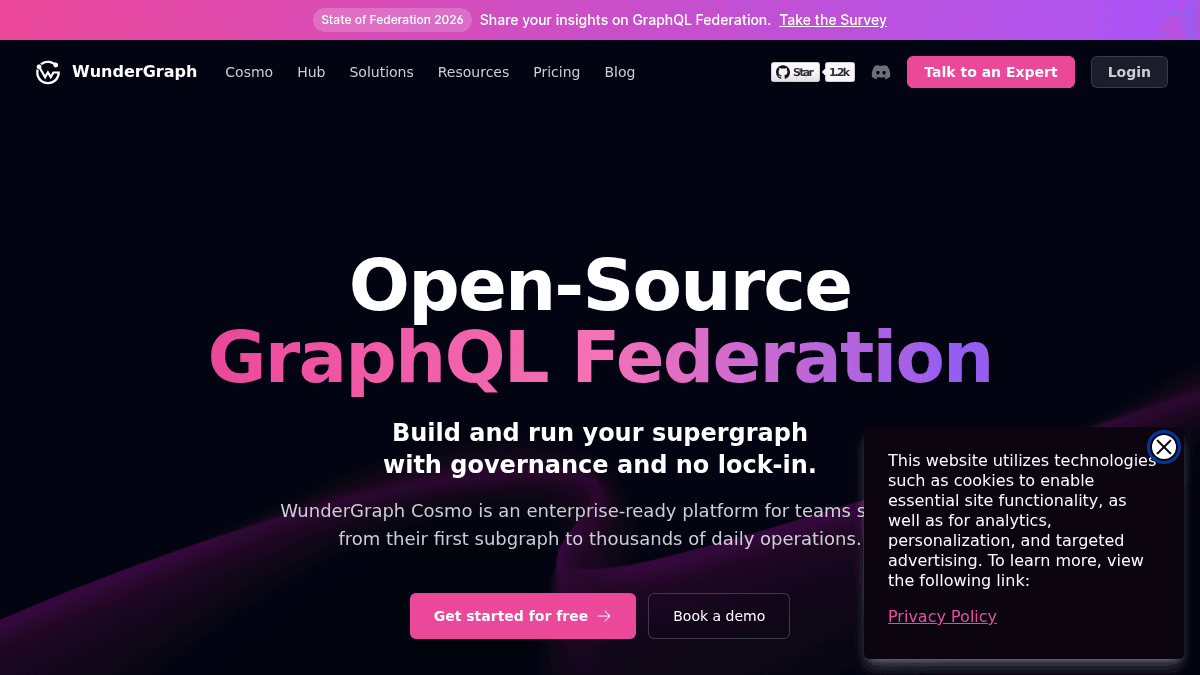
Overview WunderGraph Cosmo is an open-source GraphQL federation platform that lets teams build and run a supergraph with built-in governance and no vendor lock-in. It addresses the challenges teams face when scaling from a single subgraph to thousands of daily operations by providing an enterprise-ready platform for federated GraphQL APIs. WunderGraph Hub is a companion API design and governance platform that gives teams a shared canvas to design, review, and ship schema changes together. Together, Cosmo and Hub replace alignment meetings with structured async workflows, enabling platform teams, consumer teams, and engineering leadership to scale federation without giving up control. Key Benefits Acoustic saved an estimated $178,000 on building features that Cosmo provides out of the box. SoundCloud reduced infrastructure costs from $14,000 to $9,750 after switching to Cosmo. NerdWallet eliminated repeated 10+ second query planning delays using Cosmo's Cache Warmer, dropping planning time to under a second after warmup. Luxury Presence ships 40 deploys a day using Cosmo's safe schema change workflows. On the Beach teams find what exists and who owns every field through graph exploration. eBay chose WunderGraph as a performant open-source API platform to help teams work faster. How It Works Backend teams write plain gRPC in their language of choice. The WunderGraph router handles GraphQL query planning, batching, and entity resolution to connect any service. For real-time data, services emit events to Kafka, NATS, or Redis while the router holds every client connection and pushes updates, keeping subgraphs stateless. For AI agent endpoints, teams skip building MCP servers for every service because the router already knows the graph and turns each approved operation into an agent-ready tool with built-in authentication. Use Cases Platform engineering teams safely ship schema changes using schema proposals, automated composition checks, and breaking-change detection at the pull request stage. Consumer-facing engineering teams find what exists and who owns each field through a fully explorable graph, enabling faster design and review cycles. Engineering leadership scales federation across dozens or hundreds of subgraphs while maintaining control via open-source router, audit logs, RBAC, and self-hosted or managed cloud options. API governance teams design and govern APIs collaboratively on Hub, proposing schema changes on branches, checking against live traffic, and requiring approval from subgraph owners before merging. Teams serving AI agents expose their graph to AI agents through the MCP Gateway, which turns each approved operation into an agent-ready tool with built-in auth without building separate MCP servers. Organizations migrating from Apollo Federation use Cosmo as a drop-in replacement with advanced query planning and no usage penalties. Why Choose This Product WunderGraph Cosmo and Hub are best suited for engineering teams of any size running GraphQL federation who want open-source flexibility with enterprise governance features. The open-source router, SOC2 and HIPAA compliance, and self-hosted cloud option make it appropriate for regulated industries. Limitations include rate limiting and persisted operations being available only on the Scale tier, and SOC2/HIPAA compliance being available across all tiers.
WunderGraph Pros & Cons
- Open-source router with no lock-in
- SOC2 and HIPAA compliance across all tiers
- Teams report significant cost savings versus Apollo
- Cache Warmer eliminates repeated query planning delays
- Supports Apollo Federation v1 and v2
Key Features
Connect any service
Backend teams write plain gRPC in any language and the router handles query planning, batching, and entity resolution.
Event-driven subscriptions
The router holds every client connection and pushes updates from Kafka, NATS, or Redis so subgraphs stay stateless.
MCP Gateway
The router turns each approved GraphQL operation into an agent-ready tool with built-in authentication.
Breaking change detection
Schema proposals and automated composition checks catch problems at the pull request before they ship.
Graph exploration & ownership
Every field has an owner and the entire graph is explorable so teams design and review faster.
Cache warming
Cache Warmer eliminates repeated query planning delays in high-load scenarios.
Analytics & tracing
Distributed tracing using OpenTelemetry (OTEL) for monitoring and debugging requests.
WunderGraph Pricing
View full pricing →- Self-Hosted Router
- 1 Federated Graph
- Up to 10M Requests per month
- Discord Community Support
- Self-Hosted Router
- 2 Federated Graphs
- Up to 250M Requests per month
- Email Support
- Self-Hosted Router
- 5 Federated Graphs
- Up to 1B Requests per month
- 30 days of Data Retention
- SSO, RBAC
- Standard SLA
- Slack Connect
- Self-Hosted Router
- Custom number of Federated Graphs
- Up to 99.99% uptime SLA
- Incident response SLA
- Customizable MSA
- Dedicated Cloud Environment available
- Dedicated Solution Architect & Priority Support
| Feature | Developer Free/mo | Launch $499/mo | Scale $3499/mo | Enterprise Custom |
|---|---|---|---|---|
| Self-Hosted Router | ||||
| 1 Federated Graph | ||||
| Up to 10M Requests per month | ||||
| Discord Community Support | ||||
| 2 Federated Graphs | ||||
| Up to 250M Requests per month | ||||
| Email Support | ||||
| 5 Federated Graphs | ||||
| Up to 1B Requests per month | ||||
| 30 days of Data Retention | ||||
| SSO, RBAC | ||||
| Standard SLA | ||||
| Slack Connect | ||||
| Custom number of Federated Graphs | ||||
| Up to 99.99% uptime SLA | ||||
| Incident response SLA | ||||
| Customizable MSA | ||||
| Dedicated Cloud Environment available | ||||
| Dedicated Solution Architect & Priority Support |
Pricing extracted from the product website and may change. Check the source for current details.