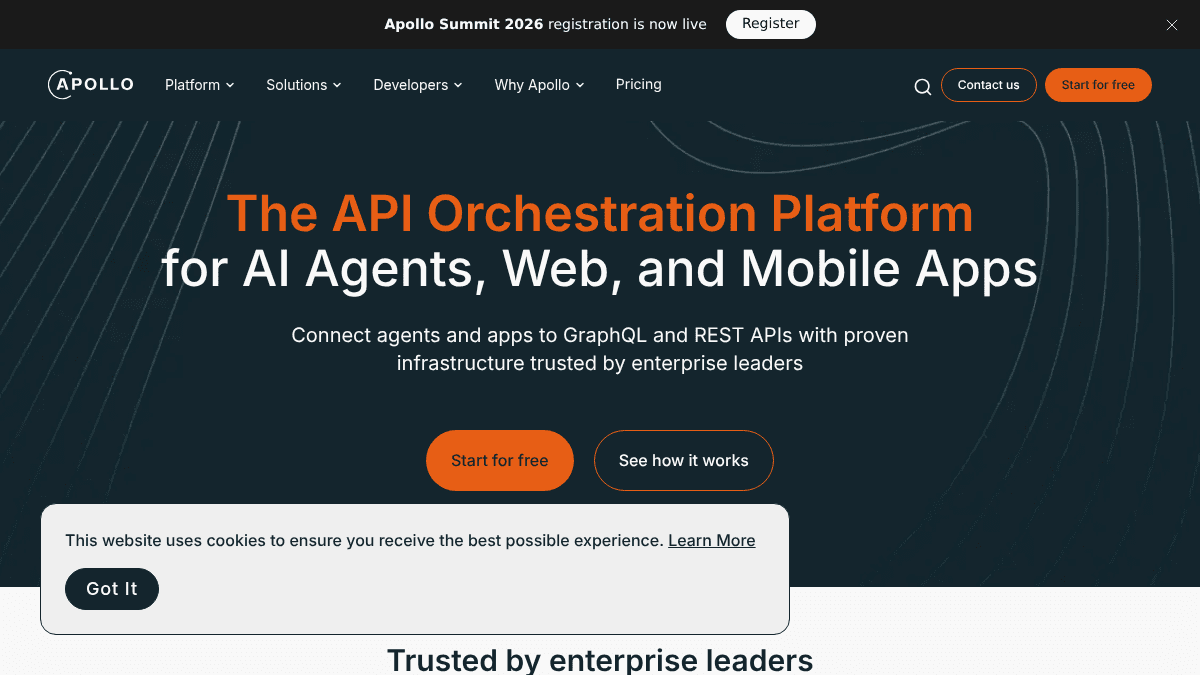
About Apollo GraphOS
Overview Apollo GraphOS is a cloud-native API orchestration platform that connects AI agents, web apps, and mobile apps to GraphQL and REST APIs. It solves the problem of managing and unifying disparate APIs across an organization by providing a single GraphQL-based orchestration layer. The platform is built for developers and enterprises that need to scale API access across multiple teams and services. Unlike point-to-point REST integrations, Apollo uses a supergraph architecture to bring all APIs together on a declarative query-based platform. Key Benefits Connect agents and apps to both GraphQL and REST APIs through a single orchestration layer. Accelerate app development by bringing all APIs together in minutes on a declarative GraphQL platform. Secure API access to agentic AI workflows with built-in authentication and authorization features. Visualize API performance and usage with built-in observability, telemetry, and tracing tools. Manage schema changes collaboratively with Schema Proposals, version control, and linting. Trusted by enterprise leaders including Netflix, PayPal, The New York Times, and Expedia Group. How It Works You start by connecting your existing REST and GraphQL APIs to Apollo GraphOS using Apollo Connectors or the GraphOS Router. The platform builds a unified supergraph that lets you query all your data sources through a single GraphQL endpoint. You then use GraphOS Studio to author, manage, and test GraphQL operations, monitor API performance with built-in observability and tracing, and manage schema changes through Schema Proposals and version control. Use Cases AI agent developers — connect AI agents to existing REST and GraphQL APIs using Apollo MCP Server for secure, structured data access. Platform engineering teams — build a unified GraphQL layer across multiple microservices and REST endpoints to reduce frontend-to-backend complexity. Enterprise architects — orchestrate API access during mergers and acquisitions to unify disparate systems under a single graph. Mobile app developers — power mobile applications with real-time data through federated subscriptions and response caching. Platform teams at large organizations — scale GraphQL across multiple teams and services with role-based access, audit logging, and SSO. Why Choose This Product Apollo GraphOS is best suited for development teams and enterprises that need to orchestrate multiple APIs — both GraphQL and REST — under a single, managed platform. The free tier supports up to 3 developers with a self-hosted router limited to 60 requests per minute, making it accessible for learning and hobby projects. Production use requires the Developer tier or above, with pricing based on API request volume.
Apollo GraphOS Pros & Cons
- Free tier available with no credit card required
- Supports both GraphQL and REST APIs
- Trusted by Fortune 500 companies like Netflix and PayPal
- Built-in observability, tracing, and performance insights
- Schema management with proposals, version control, and linting
- Free tier limited to 60 requests per minute
- Free tier supports only up to 3 developers
- Subscription update events metered separately
- Some features like Contracts and Audit logs restricted to higher tiers
Key Features
API Orchestration
Unifies GraphQL and REST APIs into a single supergraph with declarative query-based access.
AI Agent Connectivity
Apollo MCP Server connects AI agents to your existing REST and GraphQL APIs for secure data access.
REST API Connectors
Apollo Connectors provide declarative GraphQL orchestration for existing REST APIs without migration.
Performance Insights
Visualize API performance and usage with built-in observability, OpenTelemetry traces, and field-level latency data.
Schema Management
Manage schema changes with Schema Proposals, version control via Schema Registry, and automated linting and checks.
API Security
Secure GraphQL APIs from malicious requests with JWT authentication, request authorization, and demand control.
Studio Explorer
A web-based IDE for authoring, managing, and testing GraphQL operations directly in the browser.
Response Caching
Query plan and response caching to improve API performance and reduce backend load.
Access Management
Secure your GraphOS organization with role-based access, SSO, and audit logging across all tiers.
Apollo GraphOS Pricing
View full pricing →- GraphOS complete API management platform
- Supports any GraphQL API
- Self-hosted GraphOS Router (limited to 60 req/min)
- GraphQL Federation, Connectors, Response Caching
- Schema Proposals collaboration workflows
- Single sign-on (SSO) and audit logging
- GraphOS complete API management platform
- Self-hosted GraphOS Router (no rate limit)
- GraphQL Federation, Connectors, Response Caching
- Schema Proposals collaboration workflows
- Up to 10 developers
- 7-day data retention for checks and insights
- GraphOS complete API management platform
- Self-hosted GraphOS Router
- Up to 30 developers
- 90-day data retention for checks and insights
- Standard Support with SLA
- Schema Proposals and audit logging
- GraphOS complete API management platform
- Self-hosted GraphOS Router
- Unlimited developers
- 18-month data retention for checks and insights
- Business Support 24x7x365 with SLA
- Premium Support and Professional Services add-ons
| Feature | Free Free/mo | Developer $5/mo | Standard Custom/mo | Enterprise Custom/mo |
|---|---|---|---|---|
| GraphOS complete API management platform | ||||
| Supports any GraphQL API | ||||
| Self-hosted GraphOS Router (limited to 60 req/min) | ||||
| GraphQL Federation, Connectors, Response Caching | ||||
| Schema Proposals collaboration workflows | ||||
| Single sign-on (SSO) and audit logging | ||||
| Self-hosted GraphOS Router (no rate limit) | ||||
| Up to 10 developers | ||||
| 7-day data retention for checks and insights | ||||
| Self-hosted GraphOS Router | ||||
| Up to 30 developers | ||||
| 90-day data retention for checks and insights | ||||
| Standard Support with SLA | ||||
| Schema Proposals and audit logging | ||||
| Unlimited developers | ||||
| 18-month data retention for checks and insights | ||||
| Business Support 24x7x365 with SLA | ||||
| Premium Support and Professional Services add-ons |
Pricing extracted from the product website and may change. Check the source for current details.
Frequently asked questions about Apollo GraphOS
Is there a free tier available?
Yes, Apollo offers a Free tier for students or hobbyists learning GraphQL tools. It includes the full GraphOS platform with a self-hosted router limited to 60 requests per minute, supports up to 3 developers, and includes SSO, audit logging, and Schema Proposals.
How is pricing calculated?
Pricing is based on API request volume. The Developer tier starts at $5 per million standard GraphQL requests, billed monthly with automatic volume discounts as usage scales. Subscription update events are priced at $2 per million requests. New signups get $50 in usage credit.
What is included in the Free tier?
The Free tier includes the full GraphOS API management platform, support for any GraphQL API, a self-hosted GraphOS Router (rate-limited to 60 requests per minute), GraphQL Federation, Connectors, Response Caching, Federated Subscriptions, Schema Proposals, SSO, and audit logging. It supports up to 3 developers with 1-day data retention.
Does Apollo support REST APIs?
Yes, Apollo Connectors provide declarative GraphQL orchestration for REST APIs, allowing you to bring all APIs together on a query-based GraphQL platform. The platform also supports connecting AI agents to your APIs via the Apollo MCP Server.
Is Apollo GraphOS free?
Apollo GraphOS offers a free plan with optional paid upgrades. See the pricing section for what's included in each tier.
How much does Apollo GraphOS cost?
Apollo GraphOS offers the following plans: Free, Developer, Standard, Enterprise. See the pricing section for what's included in each tier and any per-seat or usage-based costs.