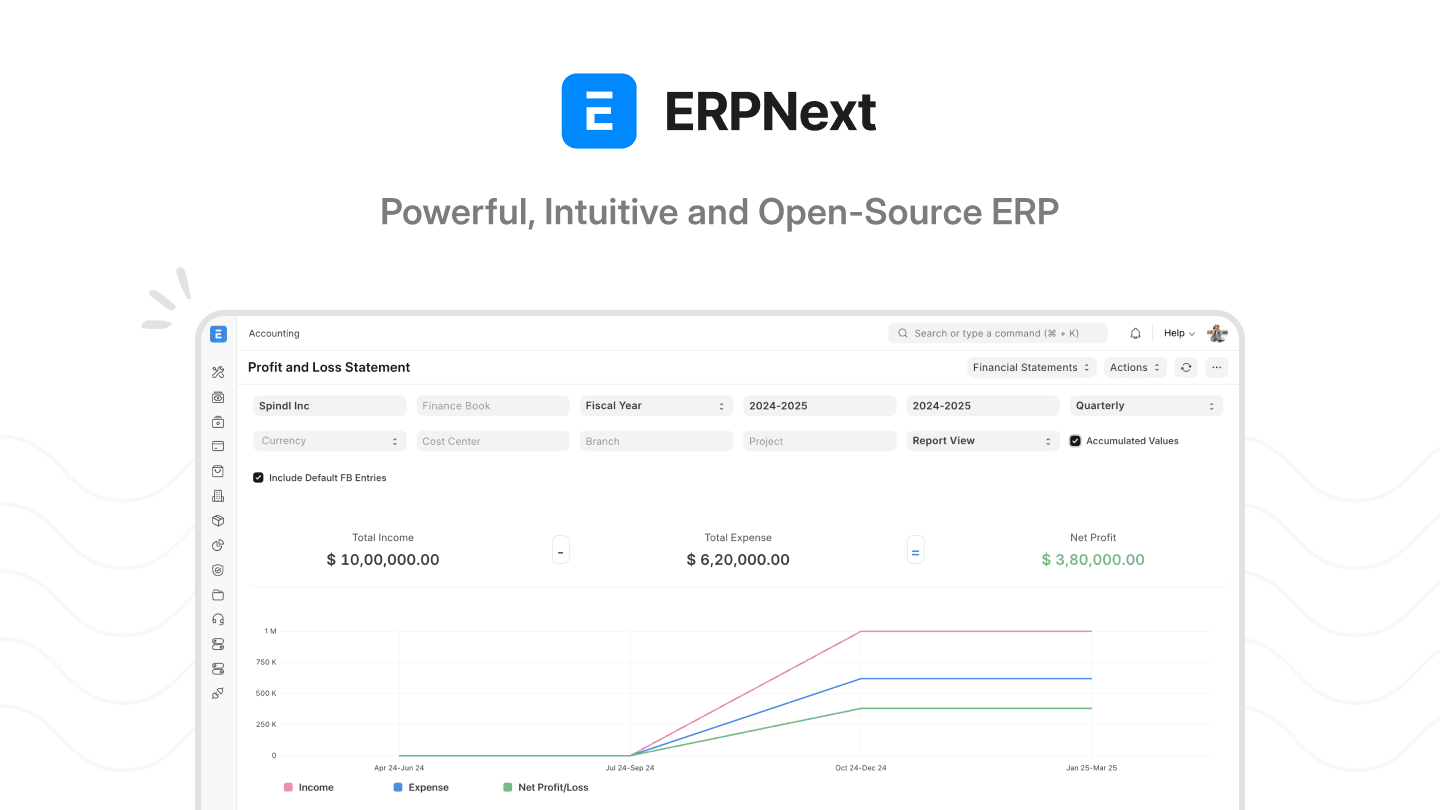
About Open Source Cloud ERP Software | ERPNext
Overview
ERPNext is a 100% open-source enterprise resource planning (ERP) software that covers accounting, procurement, sales, CRM, stock, manufacturing, projects, point of sale, quality, support, and HR & payroll in a single application. It works out of the box for almost any industry and country and can be adapted to unique needs with its built-in low-code, no-code builder. More than 30,000 companies have adopted ERPNext.
There are no features hidden behind expensive paywalls; the software is free to use, modify, or resell, giving organizations full freedom and control. Businesses can self-host under the AGPL-3.0 license or run on Frappe Cloud, Frappe's managed hosting platform.
Key Benefits
- 100% open source with no paid features hidden behind paywalls
- No per-user pricing; costs scale only with hosting or compute
- One app for accounting, inventory, manufacturing, CRM, HR, and POS
- Multi-subsidiary and multi-currency accounting with consolidated reports
- No-code and low-code builder for custom forms, workflows, and dashboards
- API-first design for integrating external systems
How It Works
Businesses host ERPNext either on Frappe Cloud, a managed hosting platform for Frappe apps, or on their own servers using installation scripts. They then choose an implementation path: self-implementation with documentation, a Success Pack from certified partners for small teams, or a dedicated partner engagement for larger businesses. Once live, teams run daily operations across all modules from any device, including mobile.
Use Cases
- Manufacturing companies plan production, track work orders and job cards, and manage subcontracting
- Trading and distribution businesses run the procure-to-pay and order-to-cash cycles with approvals
- Retailers operate cloud-based, multi-store point of sale with collections and shift management
- Service firms such as consultancies, IT services, and legal practices manage projects, timesheets, invoicing, and CRM
- Multi-subsidiary groups consolidate financial statements across currencies and entities
- Education institutes and non-profits run operations with discounted plans
Why Choose This Product
ERPNext removes vendor lock-in and per-user fees, so software costs do not grow linearly as a business scales. Frappe, the maintainer, provides managed hosting, enterprise support, and a global network of 200+ certified partners, while the source code has remained open since 2009.
Open Source Cloud ERP Software | ERPNext Pros & Cons
- 100% open source with no paid features hidden behind paywalls
- No per-user pricing; costs scale only with compute or hosting
- One app covering accounting, CRM, stock, manufacturing, HR, and POS
- 30,000+ companies have adopted ERPNext
- 200+ certified global partners for implementation and support
- Frappe does not offer implementation services directly; you work with partners
- Basic server tier has limited uptime guarantees and incident-only support
Key Features
Accounting suite
Handles multi-subsidiary, multi-currency accounting with a general ledger, payables and receivables, fixed assets, and consolidated financial statements.
Inventory and stock
Tracks items, warehouses, serial and batch numbers, and a stock ledger with inventory reports.
Manufacturing module
Manages multi-level bills of materials, production planning, work orders, job cards, and subcontracting.
CRM and sales
Covers leads, opportunities, quotations, sales orders and invoicing, pricing rules, and SLA management.
Point of sale
Runs cloud-based, multi-store POS with collections, invoicing, and shift management.
No-code builder
Automates tasks with drag-and-drop workflows, custom forms, print formats, and dashboards.
Granular permissions
Provides field-level roles and permissions to control access to data.
Global accounting
Reports across multiple subsidiaries, branches, and currencies with out-of-the-box or configurable tax compliance.
API-first integrations
Integrates with third-party systems through a RESTful API and marketplace apps.
Open Source Cloud ERP Software | ERPNext Pricing
View full pricing →- Single site with multiple apps on shared servers
- Managed upgrades and backups
- Lowest entry cost
- Scripting and custom apps
- Product Warranty
- Hosting on shared servers
- Shared or dedicated instances
- Unified or separate app and DB
- Best price-performance ratio
- Limited uptime guarantees
- Incident support only
- Superior dedicated server isolation
- Server snapshots and autoscaling
- Stronger reliability guarantees
- Global data centre locations
- Product Warranty
| Feature | Sites $5/mo | Servers $20/mo | Servers Pro $125/mo |
|---|---|---|---|
| Single site with multiple apps on shared servers | |||
| Managed upgrades and backups | |||
| Lowest entry cost | |||
| Scripting and custom apps | |||
| Product Warranty | |||
| Hosting on shared servers | |||
| Shared or dedicated instances | |||
| Unified or separate app and DB | |||
| Best price-performance ratio | |||
| Limited uptime guarantees | |||
| Incident support only | |||
| Superior dedicated server isolation | |||
| Server snapshots and autoscaling | |||
| Stronger reliability guarantees | |||
| Global data centre locations |
Pricing extracted from the product website and may change. Check the source for current details.
Frequently asked questions about Open Source Cloud ERP Software | ERPNext
How is ERPNext different from other ERP systems for small businesses?
ERPNext is fully open-source, cost-effective, and designed with small and medium businesses in mind. It offers an intuitive interface, no per-user fee, and no vendor lock-in, helping growing businesses reduce total cost of ownership compared with legacy ERP software.
Can ERPNext scale as my business grows?
Yes. ERPNext supports multi-company setups, user roles, advanced user permissions, and high transaction volumes, and can be extended with additional modules, custom workflows, and third-party integrations. With no per-user fee, you pay only for the extra compute capacity needed, so cost does not increase linearly with scale.
Do I need to hire an IT team to implement ERP software like ERPNext?
Not necessarily. Many small businesses set up ERPNext on their own using the online documentation. For basic implementations, Success Packs from certified partners help you get started quickly, while more complex setups can use a dedicated implementation partner.
How long does it take to fully implement ERPNext?
For most small businesses, an implementation takes anywhere from 2 to 8 weeks. Deployments with standard modules like Accounting, CRM, and Inventory are often faster, while advanced features such as Manufacturing or custom workflows may require additional planning and data migration.
What kind of support and training does Frappe provide after deployment?
ERPNext offers free online documentation, community forums, video tutorials, and technical support via HelpDesk from the ERPNext team. If you implemented through a certified partner, they fix basic issues and escalate advanced cases and bug fixes to the Frappe team.
Can ERPNext integrate with other software I'm already using?
Yes, ERPNext integrates with other business tools through its RESTful API and a growing ecosystem of Marketplace apps. Documented integrations include payment gateways such as Stripe and PayPal, ecommerce platforms such as Shopify and WooCommerce, backup tools like Dropbox and Google Drive, and bank integrations like Plaid.