


A guided operating system to validate an idea, plan the product, build it, launch it, win the first users, automate operations, and improve with evidence.


Community Box
Community-created content. Trust and indexing decisions remain separate.
Turn a broad idea into a clearly defined, evidence-backed problem worth solving.
A required evidence checklist before the user can mark the stage complete.
Problem, customer, proposed outcome, assumptions, risks, and evidence.
What painful problem are you solving, written in the customer's own words? Avoid describing your solution here.
Who specifically has this problem? Name a narrow segment, not "everyone who..."
What does success look like for this customer once the problem is solved?
List the riskiest assumptions this idea depends on — the ones that would kill it if wrong.
What could go wrong: market, technical, distribution, regulatory, or founder-fit risk?
What have you already observed — search volume, competitor activity, direct conversations — that supports this problem being real and painful?
Competitors, positioning, pricing, audience, strengths, weaknesses, and gaps.
For each direct or adjacent competitor, fill in one row:
| Competitor | Positioning | Pricing | Audience | Strengths | Weaknesses | Gap you could fill |
|---|---|---|---|---|---|---|
Look for a recurring gap across multiple rows — a weakness or unmet need several competitors share is a stronger signal than a one-off complaint about a single competitor.
Problem-focused questions that avoid pitching the solution too early.
Rule: do not describe your product idea until the interview is over.
Scores pain, urgency, reach, willingness to pay, founder fit, and distribution access.
Opportunity score (0-10): 0
Prompts for market mapping, interview synthesis, objection discovery, and niche refinement.
"I'm exploring [problem/idea] for [target customer]. List the main categories of existing solutions (including manual workarounds and non-software options), the leading products in each category, and where the underserved gaps appear to be."
"Here are notes from N customer interviews about [problem]: [paste notes]. Identify the 3-5 most frequently repeated pains, group them by theme, and flag any pain mentioned by more than half the interviewees."
"I'm proposing [one-line solution] to [target customer] for [problem]. List the most likely objections a skeptical version of this customer would raise, grouped by price, trust, switching cost, and timing."
"Given this broad target customer: [description], and this evidence: [evidence], suggest 3 narrower sub-segments that would let me get to a stronger product-market fit faster, and explain the tradeoff of narrowing to each."
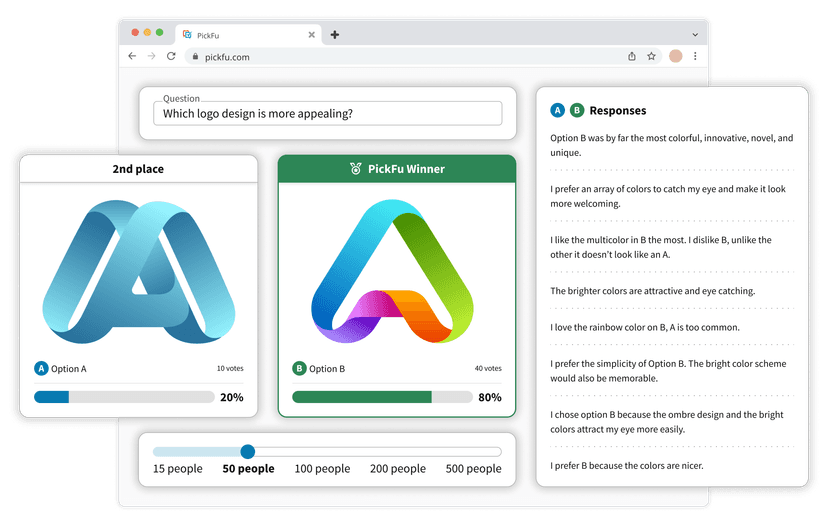
See what the world is searching for — explore trending search queries, compare interest over time, and download search trend data for analysis
Search-interest direction and geographic comparison.

Benchmark competitors, uncover market trends, and grow your digital presence with AI-powered web, app, and sales intelligence.
Competitor traffic and channel-level market signals.

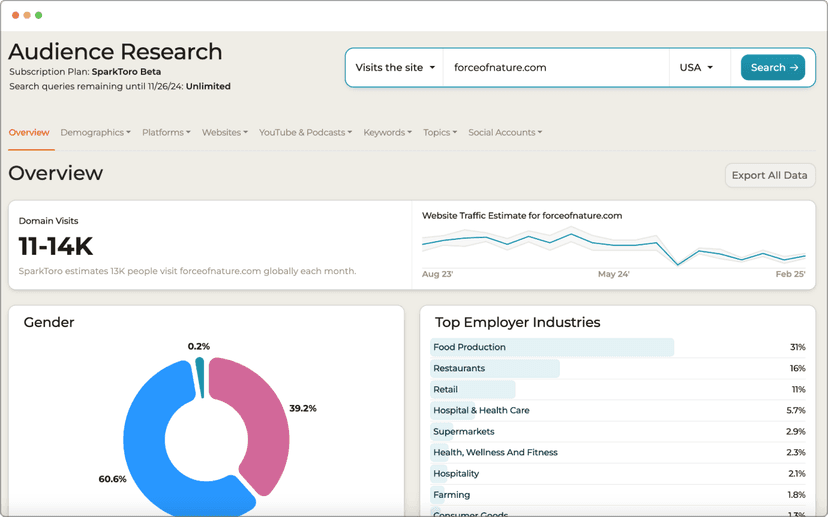
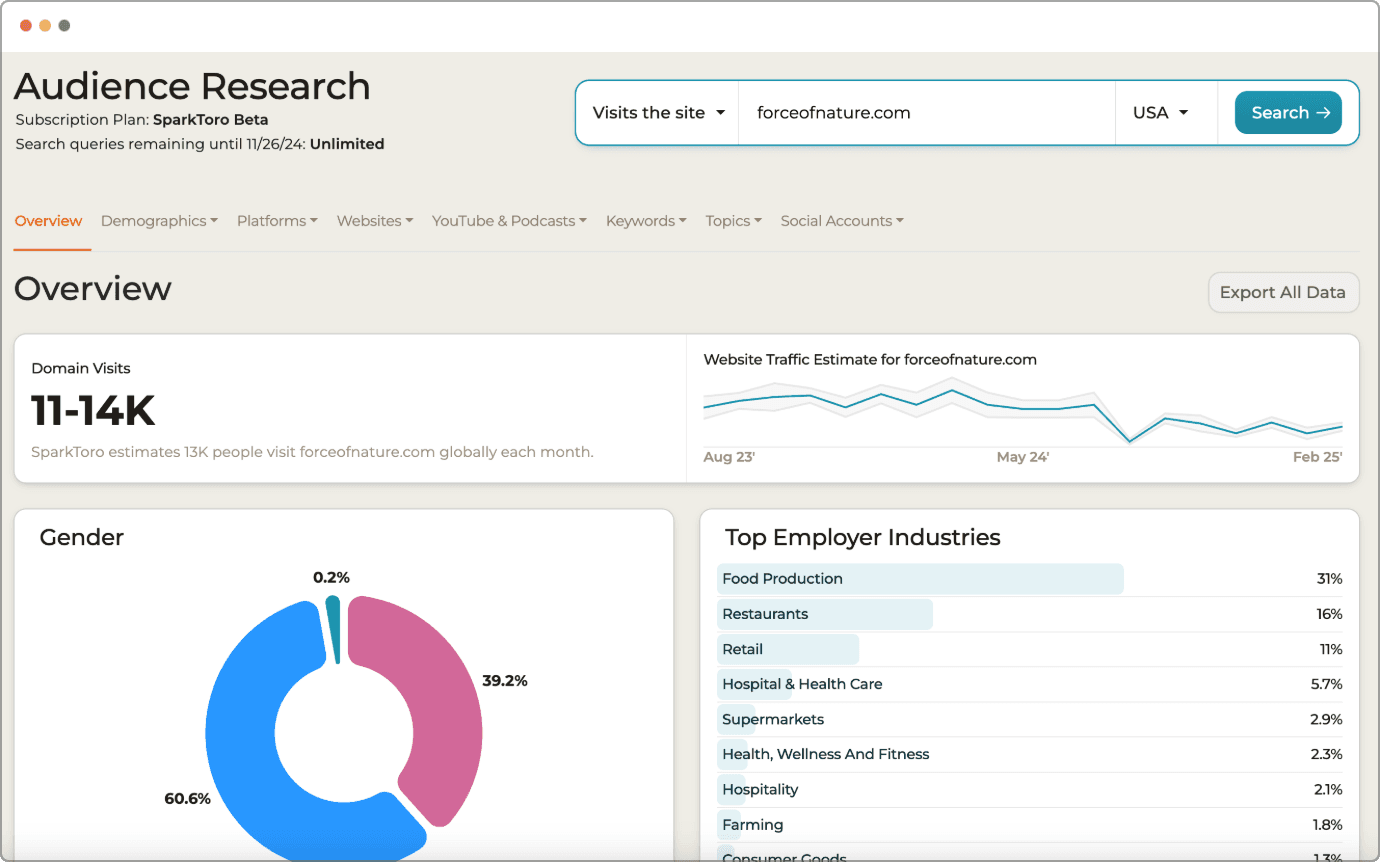
Find the podcasts, YouTube channels, social accounts, and websites your target audience actually engages with — build smarter campaigns with real audi...
Audience sources, creators, websites, and channels.
Other good options (5)

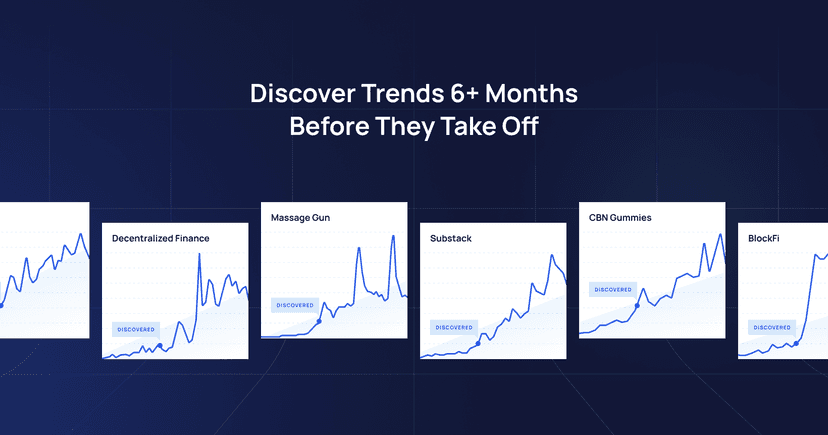
Spot emerging trends, startup opportunities, and untapped markets 12+ months before they go mainstream using data-driven trend intelligence.
Early trend and emerging-market discovery.

Grow and measure brand visibility across SEO, AI search, PPC, social, and more with the leading digital visibility platform
Keyword, competitor, content, and search-demand research.

Make your business discoverable in search, AI, and beyond — with tools and data to grow traffic, visibility, and revenue.
Search-demand, ranking, backlink, and competitor research.

Build AI-powered conversational forms that boost completion rates by 2x, enrich leads automatically, and run AI-moderated research — all in one platfo...
More polished research surveys and branching forms.
Convert validated evidence into a focused product definition, scope, pricing hypothesis, and delivery roadmap.
Required evidence before the user can mark this stage complete.
Problem, segments, value proposition, channels, revenue, costs, metrics, and advantage.
The top 1-3 problems worth solving, from your Stage 1 evidence.
Who has this problem? Include early adopters specifically — who would try this before it's proven?
A single, clear sentence: why is this different and worth switching to?
The smallest set of features that deliver the value proposition — not the full product vision.
How will you reach customers — the paths you actually have access to, not aspirational ones.
How does this make money? Be specific about the model, not just "subscription."
What does it cost to build, run, and acquire a customer?
The 2-3 numbers that would tell you this is working.
What can't be easily copied or bought by a competitor — your specific edge.
Problem, user story, desired outcome, scope, non-goals, flows, requirements, and acceptance criteria.
Restate the validated problem this release addresses.
As a [customer], I want to [action], so that [outcome].
What changes for the user once this ships? Describe the outcome, not the feature.
The specific, small set of capabilities included in this release.
What you are explicitly NOT building yet, and why — this is what keeps scope small.
Step-by-step: what does the user do, screen by screen or action by action?
Functional requirements (what it must do) and constraints (performance, security, compliance).
The specific, testable conditions that mean this is done and correct.
Jobs, pains, triggers, alternatives, buying objections, and success definition.
What is this person actually trying to accomplish — the underlying job, not the feature request?
What makes that job hard, slow, expensive, or risky today?
What event causes them to start looking for a solution right now?
What do they use instead today — including manual workarounds and "doing nothing."
What would stop them from trying or paying for this?
How would this specific person describe success, in their own words?
Reach, impact, confidence, effort, and automatic ranking.
RICE score (higher = higher priority): —
Price, users, conversion, churn, costs, and revenue scenarios.
Projected net monthly revenue ($): 0
Now, next, later structure tied to outcomes rather than feature promises.
Organize by outcome, not by feature name — each column answers "what measurable change are we going after," with the specific work underneath it.
Outcome: ____. Work in progress toward it: ____.
Outcome: ____. Why it's next, not now: ____.
Outcome: ____. What needs to be true before this becomes "next": ____.
Rule: if an item doesn't map to a measurable outcome, it doesn't belong on the roadmap yet.

One AI workspace to capture knowledge, automate busywork, manage projects, and search across all your tools — replacing a dozen separate apps for your...
Default workspace for plans, documentation, and lightweight databases.

An online collaborative whiteboard where teams brainstorm, diagram, align on decisions, and move work forward — included with every Figma plan.
Fast collaborative flows, diagrams, and product workshops.
Other good options (7)

An all-in-one collaborative workspace that blends docs, spreadsheets, apps, and AI — replace Google Docs, Airtable, and Notion with one platform used ...
Interactive product documents, formulas, and operational tables.

An AI-powered visual workspace where teams and agents think, plan, and build together — align product development, run workshops, and ship faster.
Visual mapping, workshops, journeys, canvases, and prioritization.
Free online canvas tool for business brainstorming, strategy modeling and team collaboration with over 40 pre-built templates
Quick business and Lean Canvas creation.

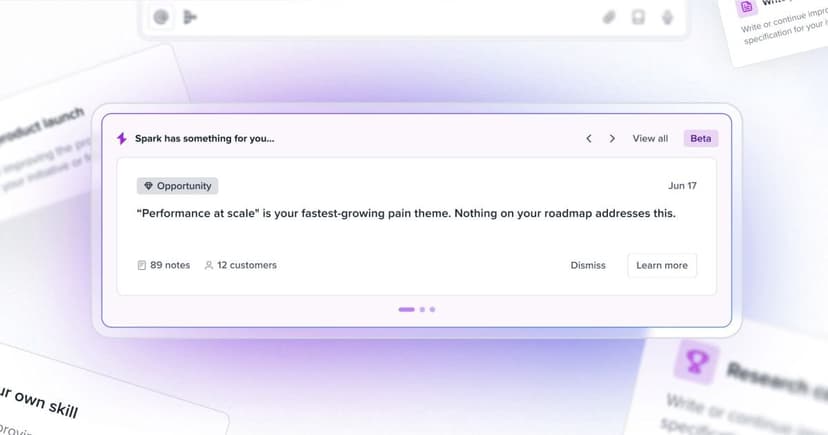
The agentic product management system that helps product makers understand customers, prioritize features, and ship the right thing with AI-powered in...
Feedback-informed product planning and prioritization.

Link strategy to roadmaps, manage customer interviews, consolidate feedback, and build prototypes with AI — all in one product management suite.
Advanced product strategy and roadmapping.
Connect customer intelligence to your product roadmap so every priority is grounded in evidence and every launch moves the business forward.
Visual product roadmaps and stakeholder communication.
Ship a secure, measurable, usable first product without creating an unnecessarily complicated technology stack.
Required evidence before the user can mark this stage complete.
Choose code, AI app builder, no-code, backend, auth, hosting, and analytics.
Pick one: Code-first (you write and review the code yourself), AI-assisted code (an AI coding editor/agent generates most of it, you review and ship), AI app builder (a prompt-based tool like v0/Lovable/Bolt generates a working app), or No-code (visual builder, no source code).
Do you need your own database and server logic, or does a managed backend (auth + database + storage in one) cover it?
Build your own, or use a dedicated auth provider? Default to a dedicated provider unless auth is core to your product's value.
Where does this deploy — a managed platform with git-push deploys, or something you operate yourself?
How will you know if the primary user journey is working, from day one?
Rule: pick the option in each row that lets you ship the primary user journey fastest — you can always migrate off a managed choice later once you have real usage data to justify the switch.
Security, mobile, accessibility, performance, privacy, backups, and error states.
Core entities, relationships, ownership, permissions, and retention rules.
List each core "thing" your product tracks (e.g. User, Account, Order) and one sentence describing what it represents.
How do entities connect — one-to-many, many-to-many? Sketch it, even as a simple list ("an Order belongs to one User").
For each entity, who owns it — the user who created it, an account/team, or the system?
Who can read, edit, or delete each entity? Note any role-based rules now, before they're tangled into the code.
What happens to each entity when a user deletes their account or cancels — deleted immediately, soft-deleted, or retained for compliance?
Plan, implement, review, test, preview, deploy, observe, and roll back.
Signup, login, password reset, OAuth, roles, access, deletion, and sessions.
Feature planning, debugging, refactoring, test generation, review, and documentation.
"I want to build [feature] for [product context]. Propose the smallest implementation that satisfies this: [acceptance criteria]. List the files likely to change and any open questions before writing code."
"Here is an error and the relevant code: [paste]. Explain the likely root cause before suggesting a fix, and flag if the fix could have side effects elsewhere."
"Refactor this code for clarity without changing its behavior: [paste]. Explain each change and confirm it's behavior-preserving."
"Write tests for this function/flow: [paste], covering the primary path and the most likely edge cases and failure modes."
"Review this diff as a strict senior engineer: [paste]. Flag correctness bugs, security issues, and anything that looks like unnecessary complexity."
"Write a short, plain-language explanation of what this code does and why, for a founder who will need to maintain it without deep context: [paste]."

Describe what to build in natural language, generate full-stack web apps with AI, and deploy to production in seconds
AI-assisted interfaces and full-stack web application generation.

AI coding agent that writes, edits, and debugs your code in an IDE, terminal, Slack, and GitHub — so you focus on decisions, not boilerplate
Primary AI coding editor for code-first founders.

AI-powered code completion, agent-mode development, and enterprise-grade governance — all in your editor, CLI, and GitHub workflow.
AI assistance across code, repositories, reviews, and developer workflows.

Build production-grade applications with a Postgres database, Authentication, instant APIs, Realtime, Functions, Storage, and Vector embeddings — all ...
Default hosted Postgres, storage, authentication, functions, and APIs.

Add authentication and user management to any React, Next.js, or Remix app with drop-in UI components — includes sign-up, sign-in, B2B organizations, ...
Dedicated authentication and user-management layer.
Other good options (6)

Build apps and websites by chatting with AI — get a working prototype in real time and deploy with one click, no coding required
Prompt-based web application building for rapid founder-led shipping.

Build and scale websites, apps, and prototypes by chatting with AI — with built-in hosting, databases, SEO, and enterprise-grade infrastructure.
Browser-based AI app, website, and prototype building.
Agent-led application building and deployment in one environment.

Generate UI designs for mobile and web apps with AI — accelerate ideation and go from prompt to prototype faster.
AI-assisted interface exploration and design generation.

AI-powered prototyping tool that turns prompts into production-ready code prototypes, with full design context from your Figma system.
AI-powered functional design and prototype creation.
Create a credible, memorable brand and landing experience that clearly communicates the product's value.
Required evidence before the user can mark this stage complete.
Audience, category, promise, differentiation, personality, proof, and constraints.
Who is this brand speaking to, specifically — reuse the persona from Stage 2.
What category does this belong to in the customer's mind? Naming the category shapes what they compare you against.
The one thing this brand reliably delivers, stated plainly.
Why this over the obvious alternative — including "doing nothing."
3-4 adjectives that describe how this brand should feel, and 1-2 it should explicitly avoid.
What evidence backs the promise — data, testimonials, credentials, or demos?
Budget, timeline, or existing assets (a name you already own, a domain you already have) that shape what's realistic here.
Clarity, memorability, pronunciation, distinctiveness, domain, and expansion fit.
Name score (0-5) — score each candidate name separately: 0
Domain, redirects, email, social handles, basic legal checks, and ownership records.
Colors, typography, spacing, radius, icon style, cards, buttons, forms, and accessibility.
One primary, one accent, neutral grays, and semantic colors (success/warning/error).
One heading font (or weight) and one body font, plus a small type scale (e.g. 3-4 sizes).
A single spacing scale (e.g. 4/8/16/24/32px) applied consistently instead of ad hoc values.
One or two corner-radius values used everywhere, not a different one per component.
One icon set/style — outline or filled, one stroke weight — not mixed styles.
Define the default look for these three recurring elements once, then reuse them everywhere instead of redesigning per page.
Confirm text/background contrast meets a readable minimum and interactive elements have visible focus states.
Hero, pain, outcome, workflow, proof, FAQ, objection handling, and CTA.
One sentence: who this is for and the outcome it delivers. No jargon.
Name the specific pain in the visitor's own language, so they recognize themselves immediately.
What changes for them after using this — be concrete, not aspirational.
A short, visual walkthrough of how it actually works, in 3-4 steps.
Testimonials, usage numbers, logos, or a live demo — whatever you actually have.
Answer the 4-6 questions visitors actually ask before buying, including pricing and setup effort.
Directly address the top 1-2 reasons a skeptical visitor wouldn't convert.
One primary action, repeated at the top and bottom of the page — not multiple competing buttons.
Voice principles, allowed language, banned patterns, examples, and review checklist.
Use this as a reusable system prompt so any AI-assisted copy — landing page, emails, support replies — stays on-brand:
"You are writing copy for [product name], a [one-line description] for [target audience]. Voice principles: [e.g. direct, plain-spoken, no hype]. Always: [e.g. use 'you', short sentences, concrete numbers over adjectives]. Never: [e.g. superlatives like 'best-in-class', exclamation points, jargon like 'synergy' or 'leverage']. Here are two examples of on-voice copy: [paste 2 real examples]. Before finalizing any copy, check it against this list: does it sound like a real person, is every claim specific and true, would the target audience actually talk this way?"
Update the bracketed sections once per brand, then reuse the same prompt everywhere copy gets written.
Generate short, brandable business names with custom AI — filter by length or keywords, check domain availability, and create a matching logo, all for...
AI-assisted business and product name exploration.

An ICANN-accredited domain name registrar with competitive pricing, free WHOIS privacy, free SSL certificates, and web hosting services.
Domain registration and management.
Fast brand assets, social graphics, presentations, and launch collateral.

Design, prototype, and build products faster with AI—collaborate in one platform from first idea to shipped product
Primary product design and design-system workspace.
Other good options (6)

Generate short, available, and brandable business names instantly using A.I. — 100% free, with built-in domain search and logo creation.
Alternative naming and domain idea generation.

Search 6,188 domain name combinations, instantly check availability and trademark status, and register your ideal domain — all in one tool.
Domain-oriented name combinations and availability exploration.

All-in-one design, photo, and video tool to make social posts, flyers, logos, and videos with generative AI and brand controls
Alternative all-in-one branded content production.
AI-assisted logo and starter brand identity generation.

Build custom websites visually, rank in AI search, and drive measurable revenue — without writing a single line of code.
Advanced visual website building and content management.
Coordinate a focused launch that creates conversations, qualified traffic, feedback, and measurable activation.
Required evidence before the user can mark this stage complete.
Product, analytics, support, content, assets, channels, legal, and rollback readiness.
Preparation, soft launch, public launch, follow-up, and review.
Finalize product stability, launch assets, and submission dates. Line up 5-10 people who'll engage on launch day.
Ship to a small warm audience (existing waitlist, community, friends). Fix anything that breaks before the public push.
Execute the scheduled directory/community submissions and social posts. Monitor analytics and support closely all day.
Send follow-up email/social content to people who engaged but didn't convert. Run the launch review and record what you'd repeat or change.
Platform, audience, requirements, cost, status, date, result, and notes.
Track every launch channel in one table so nothing gets submitted twice or forgotten:
| Platform | Audience | Requirements | Cost | Status | Scheduled date | Result | Notes |
|---|---|---|---|---|---|---|---|
Fill one row per directory/community/channel before Week 1 ends, so Week 3's submissions are execution, not discovery.
Waitlist, announcement, value demonstration, proof, reminder, and feedback.
"We're building [product] to solve [problem]. Join the waitlist to get early access and shape what we build."
"We're live. [Product] does [core value] for [audience]. Here's how to get started: [link]."
Show, don't tell — a short walkthrough of the core workflow, or a before/after example.
Share an early testimonial, usage number, or case study now that you have real users.
"Haven't tried [product] yet? Here's the fastest way to see the value in under 2 minutes." Target non-openers/non-clickers from earlier emails.
"What's one thing that would make [product] more useful to you?" — ask directly, and make replying effortless.
Founder story, problem, demo, build-in-public, proof, and ask formats.
"I built [product] because [personal reason tied to the problem]. Today it's live: [link]."
Open with the pain point in the audience's own words before mentioning your product at all.
A short screen-recording or GIF showing the core workflow in under 30 seconds.
Share one specific number or lesson from building this (users, revenue, a mistake you fixed).
Quote or screenshot a real piece of user feedback, with permission.
A direct, low-friction ask: try it, share it, or answer one specific question.
Summary, founder bio, screenshots, logos, facts, links, quotes, and contact details.
A 2-3 sentence description of the product anyone could copy-paste into an article.
A short, factual bio — 2-3 sentences, no superlatives.
3-5 clean, high-resolution screenshots of the core product experience.
Logo files in a few common formats/sizes, on transparent background.
Founding date, team size, funding status (if any), and any notable numbers.
Website, product page, and primary social profile.
1-2 pre-approved founder quotes a journalist or creator can use directly.
A real email a journalist or creator can reach, monitored during launch.
Major technology-product discovery and launch platform.

Social launchpad for tech products: get guaranteed homepage visibility, a 75 DR do-follow backlink, and real community feedback to grow your product
Curated product launch and discovery platform.

Discover early-stage startups before they make it big, and get early access to tomorrow's internet products
Early-stage startup discovery and beta-user acquisition.

Send product email, marketing email, and transactional email from one platform — free to start, no per-seat fees, and pricing based on subscribed cont...
Default lifecycle, product, marketing, and transactional email for SaaS.

A developer-first email API to send transactional and marketing emails that land in inboxes instead of spam, with SDKs for 14 languages and React Emai...
Developer-focused transactional email infrastructure.
Other good options (6)
Launch products to Peerlist's community of tech and creative professionals and collect upvotes and feedback.
Builder-focused product launches and professional-community reach.
Hacker News community showcase where builders share and discuss their projects — discover new tools, get real feedback, and join technical conversatio...
Technical founder and maker launch channel.

A launchpad for dev tools where developers vote, discover, and get featured — built by developers, open source, and fair.
Launch platform focused on developer tools.

Weekly newsletter and directory of trending tech startups and side projects — get discovered by thousands of readers or find your next business idea.
Startup submission and discovery directory.

AI-powered email and SMS marketing platform that uses your customer data to automate campaigns, grow audiences, and drive revenue for businesses of al...
General-purpose email marketing and audience management.
Build a repeatable founder-led acquisition loop using search, outreach, communities, partnerships, proof, and feedback.
Required evidence before the user can mark this stage complete.
Weekly channel experiments, outreach, content, communities, demos, and feedback.
Run this loop every week rather than treating acquisition as a one-time launch push:
Indexing, metadata, internal links, schema, speed, content gaps, and conversion paths.
Problem interview, warm introduction, cold outreach, follow-up, and demo invitation.
"I'm researching how [role] handle [problem]. Would you have 15 minutes to share how you deal with it today? No pitch — just trying to understand it better."
"[Mutual contact] mentioned you deal with [problem] — I've been building something in this space and would love to get your take."
"Noticed [specific, researched detail about them]. I built [product] to solve [problem] for people like you — worth a quick look?"
"Following up in case this got buried — still happy to show you [product] if useful, no pressure either way."
"Want to see [product] in action? I can walk you through it in 15 minutes, whenever works for you: [scheduling link]."
Account, person, signal, channel, status, next action, objection, and result.
One row per lead or conversation — the point is having a single source of truth instead of memory or scattered DMs:
| Account | Person | Signal | Channel | Status | Next action | Objection | Result |
|---|---|---|---|---|---|---|---|
Review this weekly during the First 100 Users playbook loop — it's how you spot which channel and message actually convert.
Communities, norms, value contribution, content format, cadence, and learning.
List the 2-3 communities where your actual target customer already spends time.
What's acceptable there — self-promotion rules, tone, format expectations? Read them before posting.
What can you genuinely contribute before ever mentioning your product — answers, resources, feedback on others' work?
What format performs in this community — long-form posts, quick answers, threads?
How often will you show up, realistically, so you build recognition rather than appearing once and vanishing?
What are you tracking to know if this community is actually converting into users, not just activity?
Contextual prompts for feedback, proof, case studies, referrals, and permission.
"You've been using [product] for a bit now — what's one thing that's been genuinely useful, and one thing that's been frustrating?"
"Would you be open to sharing a quick quote about your experience? Even a sentence or two would help a lot."
"Your results with [product] stood out — would you be up for a short call so I can write up how you're using it?"
"Do you know anyone else dealing with [problem] who might get value from this?"
"Okay if I share what you said (with/without your name) on the site or in marketing?" — always ask explicitly before publishing.
Measure your site's Search traffic and performance, fix issues, and optimize content to perform better in Google Search results
Search indexing, visibility, query, page, and technical monitoring.

All-in-one product analytics, session replay, feature flags, and data warehouse — built for product engineers to ship products faster
Default product analytics, funnels, sessions, flags, experiments, and feedback.

Marketing, sales, service, content, and data software unified on one AI-powered CRM platform — grow your business with free and paid tools.
Free-friendly contact, conversation, deal, and follow-up management.

AI-powered B2B sales platform that unifies prospecting, lead gen, data enrichment, and deal automation to build pipeline and close deals faster
B2B prospect data and outbound workflow support.

Build systems to grow revenue with AI-powered prospecting, data enrichment, and go-to-market automation.
Lead enrichment, signals, research, and personalized growth workflows.

Use AI to capture customer feedback from sales and support conversations, prioritize features by revenue impact, and ship what drives growth.
Feature requests, feedback collection, and public roadmaps.
Other good options (5)

Free analytics tools to understand customer journeys, improve marketing ROI, and connect insights across Google advertising products
General traffic and conversion measurement.

AI-powered outbound platform that researches, personalizes, and engages prospects across email, LinkedIn, calls, WhatsApp, and SMS — all from one work...
Personalized multichannel outbound campaigns.

Understand user behavior with heatmaps, session replays, surveys, and funnels — get insights fast and improve conversions without a credit card
Heatmaps, recordings, and qualitative behavior signals.

Capture, measure and showcase customer testimonials, NPS scores, case studies, and brand mentions to convert social proof into revenue
Alternative testimonial capture and proof widgets.
Remove repetitive work while keeping important decisions, exceptions, money, and customer-sensitive actions under human control.
Required evidence before the user can mark this stage complete.
Frequency, time, error risk, value, systems, sensitivity, and recommended action.
List every recurring task before automating anything — this is what keeps you from automating the wrong thing first:
| Task | Frequency | Time spent | Error risk if wrong | Value if automated | Systems involved | Sensitivity (money/customer-facing?) | Recommended action |
|---|---|---|---|---|---|---|---|
Rule: automate high-frequency, low-sensitivity tasks first. Anything touching money or irreversible customer actions gets a human approval gate, not full automation, until it's proven.
Classify, answer, request context, escalate, log, and learn.
Enrich, score, reject, nurture, route, follow up, and record.
Signup, activation, inactivity, upgrade, renewal, failure, cancellation, and return.
Payments, tax data, invoices, receipts, failed payments, refunds, and reconciliation.
Actions AI may execute, draft, recommend, escalate, or never perform.
For every automated or AI-assisted action in the business, classify it into exactly one bucket — this is what keeps automation from silently making a decision it shouldn't:
Low-risk, easily reversible, high-volume — e.g. sending a receipt email, tagging a support ticket.
Medium-risk or customer-facing — e.g. a support reply the founder approves before sending.
The system suggests an action but a human decides — e.g. "this lead looks worth a call."
Anything ambiguous, angry, legal, or unusually high-value — routed straight to a human, no automated attempt first.
Irreversible, money-moving, or identity-sensitive actions — refunds above a threshold, account deletion, contract terms — always require a human to act.

No-code automation across 9,000+ apps — build AI workflows, create AI agents, and orchestrate tasks without writing code.
Broad no-code automation and app integration.

Build, control, and deploy AI workflows and automations visually — with full code access when you need it, self-hosting or cloud, and 500+ integration...
Default flexible workflow automation with self-hosting options.
Customer service platform that unifies inbox, AI, knowledge base, and messaging so teams resolve more conversations and build lasting customer relatio...
Human-friendly shared inbox, help center, and customer support.
Other good options (7)

Connect any app, data source, or AI model. Build and manage automations and AI agents – visually, in code, or with a prompt.
Visual automation for more complex branching and data transformation.
Build automation workflows and AI agents that connect 3,000+ APIs, with code-level control when you need it and no code when you don't
Developer-friendly API, event, and code-based workflows.

Build and deploy specialized AI agents in minutes — orchestrate multi-agent workflows, let teammates interact via Slack/Teams/email, and keep IT in co...
Visual AI-agent and business-process automation.

AI assistant that manages your inbox, schedules meetings, drafts replies in your voice, and handles follow-ups — saving you 2 hours every day.
AI assistants and operational task automation.

AI customer agent that resolves issues end-to-end across the entire customer journey, delivering industry-leading resolution rates
AI customer-support agent for scaled support workflows.
Small-business bookkeeping and financial operations.
Create a disciplined improvement loop around activation, retention, revenue, reliability, experiments, and AI operating cost.
Required evidence before the user can mark this stage complete.
Acquisition, activation, engagement, retention, revenue, referral, cost, and reliability.
One number per row, reviewed on a fixed cadence (weekly is typical for a solo founder):
| Category | Metric | This period | Last period | Trend |
|---|---|---|---|---|
| Acquisition | New signups | |||
| Activation | % reaching your "aha" moment | |||
| Engagement | Weekly/monthly active users | |||
| Retention | % still active after 30 days | |||
| Revenue | MRR | |||
| Referral | % of new users from referral | |||
| Cost | Total infra + AI cost | |||
| Reliability | Uptime / error rate |
Keep this to one screen — a scorecard you stop checking because it's too long is worse than no scorecard.
Wins, misses, metrics, insights, customer evidence, risks, decisions, and next bets.
What genuinely went well this month — specific, not vague.
What didn't go as planned, without spin.
Pull the KPI scorecard trend for the month.
What did the data or customer conversations teach you that you didn't know a month ago?
Direct quotes, tickets, or interview notes that back up (or challenge) your current plan.
What could derail next month if left unaddressed?
What are you changing based on this review — be specific and time-bound.
The 1-3 things you're prioritizing next month and why.
Logo retention, revenue retention, cohort retention, churn, and recovery scenarios.
Net revenue retention (%) — above 100% means expansion outpaces churn: —
Hypothesis, audience, change, metric, guardrail, duration, result, and decision.
One row per experiment — the discipline is writing the hypothesis and guardrail down BEFORE you look at results:
| Hypothesis | Audience | Change | Success metric | Guardrail metric | Duration | Result | Decision |
|---|---|---|---|---|---|---|---|
A guardrail metric is something that must NOT get worse (e.g. support tickets, churn) even if the success metric improves.
Model, tokens, requests, cost, latency, task, quality, user, and margin.
AI cost per user per month ($) — compare against revenue per user for margin: —
Impact, timeline, detection, root causes, response, fixes, and prevention.
Who and what was affected, and for how long?
What happened, in order, from first symptom to resolution?
How did you find out — monitoring, or a user reporting it? (If a user found it first, that's itself a finding.)
What actually caused this — not just the immediate trigger, but the underlying gap that allowed it.
What did you do to mitigate or fix it, and how long did that take?
What's changing in the product or process as a direct result?
What would need to be true for this specific failure to be impossible (or caught immediately) next time?

All-in-one product analytics, session replay, feature flags, and data warehouse — built for product engineers to ship products faster
Default all-in-one product analytics and experimentation layer.

Open source AI analytics platform that lets you query data in natural language, build self-service dashboards, and embed customer-facing analytics — d...
Open-source business intelligence and internal dashboards.
Subscription analytics and insights platform that helps SaaS businesses track metrics, recover failed payments, forecast revenue, and reduce churn.
Subscription revenue, churn, forecasting, and SaaS metrics.

Fix application errors and performance issues faster with connected traces, logs, replays, and AI-powered root cause analysis — all from a single SDK.
Application errors, performance, releases, and issue diagnosis.
Other good options (10)

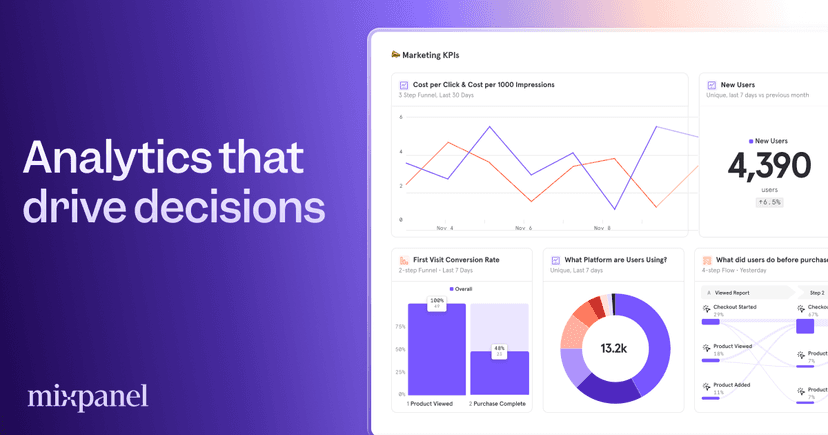
Product analytics platform that helps teams track user behavior, measure conversions, improve retention, and get proactive AI-driven insights — no dat...
Event analytics, funnels, retention, cohorts, and product behavior.

AI-powered product analytics platform that helps teams understand user behavior, run experiments, and get real-time answers from data without dashboar...
Advanced digital analytics and experimentation.

Privacy-first Google Analytics alternative. Track visitor behavior, measure conversions, and analyze traffic without cookies or complexity.
Simple, privacy-friendly website analytics.
Build interactive dashboards and shareable reports from your data — free with Google-native and partner connectors, real-time collaboration, and embed...
Free-friendly dashboards across Google and connected data sources.

AI-powered analytics that turns business performance data into clear answers your team can understand, explain, and act on instantly
Cross-source KPI dashboards and business reporting.

Unite subscription analytics, revenue forecasting, and SaaS benchmarks into one real-time view — track performance and automate growth workflows for a...
Subscription analytics, revenue reporting, and SaaS growth data.

Run experiments, manage feature flags, analyze product data, and replay sessions — all in one platform with a generous free tier backed by enterprise-...
Feature flags, experiments, metrics, and product-development measurement.

Run A/B, split URL, and multivariate tests across web, mobile, and server-side to boost conversions and optimize digital experiences
Conversion experimentation and digital-experience optimization.

Route, debug, and analyze LLM API calls with an open-source AI gateway and observability platform built for teams scaling AI applications.
AI gateway and LLM request observability. Alternative for AI products.