About Schema.org
Overview
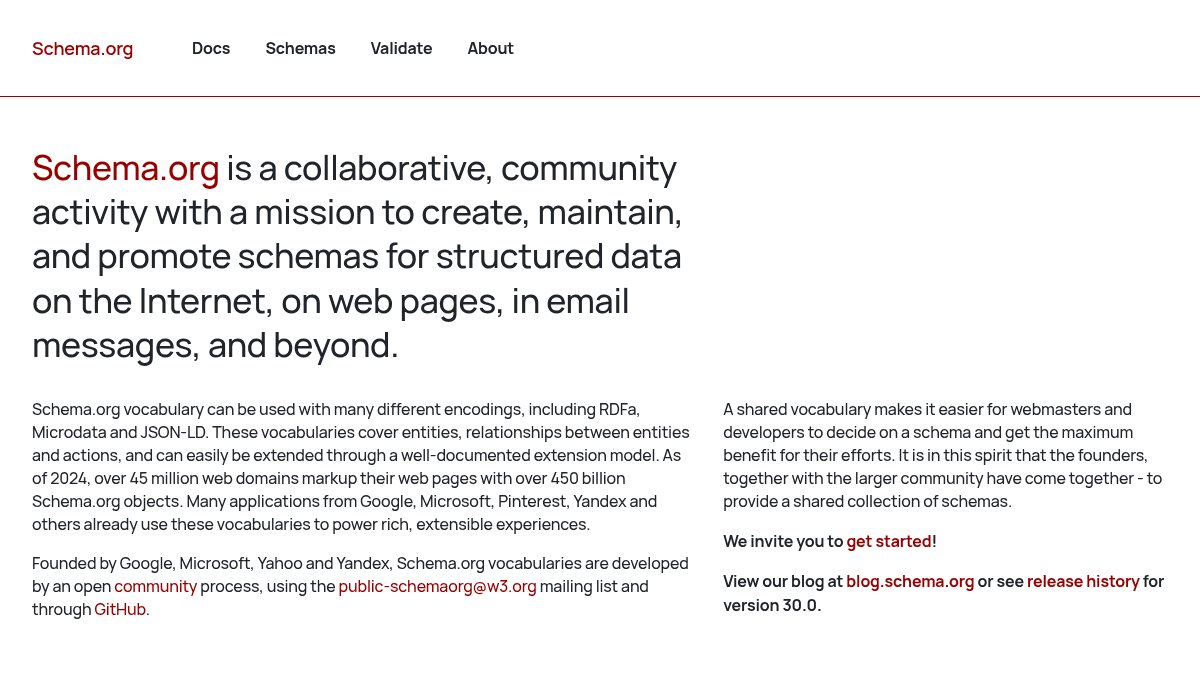
Schema.org is a collaborative, community-driven vocabulary for structured data on the Internet, covering entities, relationships between entities, and actions. Webmasters and developers use these schemas to embed machine-readable structured data on web pages and in email messages, enabling search engines and other applications to parse and understand their content. Unlike proprietary markup formats, Schema.org provides a single shared vocabulary supported across multiple search platforms.
Founded by Google, Microsoft, Yahoo, and Yandex, Schema.org develops and maintains its vocabularies through an open community process using the [email protected] mailing list and GitHub. As of 2024, over 45 million web domains use Schema.org to markup their pages, deploying more than 450 billion Schema.org objects across the web. The current release is version 30.0.
Key Benefits
- Over 45 million web domains use Schema.org vocabularies to markup their content for search engines
- More than 450 billion Schema.org objects are deployed across the web as of 2024
- Applications from Google, Microsoft, Pinterest, and Yandex use these vocabularies to power rich and extensible experiences
- An open community process through a W3C mailing list and GitHub keeps vocabularies current and responsive to real-world needs
- A shared vocabulary helps webmasters and developers decide on a schema and get maximum benefit for their efforts
- Vocabularies can be easily extended through a well-documented extension model for domain-specific needs
How It Works
Webmasters and developers select a schema from the shared vocabulary collection, then embed structured data on their web pages using RDFa, Microdata, or JSON-LD encodings. Search engines and applications from Google, Microsoft, Pinterest, and Yandex then consume this markup to generate rich search results and extensible experiences for end users.
Use Cases
- SEO specialists markup web pages with structured data to improve visibility in Google, Bing, and other search results
- Web developers embed structured entity and relationship data in web pages using JSON-LD, RDFa, or Microdata
- Email marketers include Schema.org markup in messages for enhanced inbox rendering
- Search engine engineers at Google, Microsoft, Yandex, and Pinterest build rich result features that consume Schema.org vocabularies
- Open-source contributors propose, discuss, and refine schemas through the public mailing list and GitHub
- Extension developers use the documented extension model to create domain-specific vocabularies beyond the core set
Why Choose This Product
Schema.org suits webmasters and developers who need a shared, community-maintained vocabulary that major search engines already support. The open community process means anyone can contribute through the W3C mailing list or GitHub, and the extension model allows adaptation to specific domains beyond the core vocabulary.
Schema.org Pricing
Pricing extracted from the product website and may change. Check the source for current details.