
About nodrix
Overview
nodrix is an open-source IoT backend that you deploy into your own Cloudflare account. Hardware sends telemetry over plain HTTPS or opens a WebSocket, and every metric that arrives becomes a variable automatically — no schema, no MQTT broker, no SDK.
The whole stack runs on Cloudflare primitives: Workers, Durable Objects, D1, R2, and KV. Every deploy is single-tenant, so ingest, storage, dashboards, and automations live on your own account and your data never passes through a third party.
Key Benefits
- Deploy in one click, with D1, R2, KV, and the Worker provisioned straight into your own Cloudflare account.
- Send a plain JSON POST and nodrix creates the variables for you on first sight.
- Watch values update live on drag-and-drop dashboards that sit on hibernating WebSockets and cost nothing while idle.
- Skip the message broker entirely: hardware talks HTTPS or WebSocket to your worker URL.
- Read latest state and recent time-series from any app through one edge-cached REST call behind a bearer token.
- Keep data single-tenant, because each deployment lands on your own database and storage rather than a shared vendor cloud.
How It Works
You hit Deploy to Cloudflare, which provisions D1, R2, KV, and the Worker inside your account. You open the worker URL, create the first account to become the owner, and spin up a project in a couple of clicks. Next you mint a project token and point the device at /v1/telemetry, and variables appear as soon as data starts flowing. Finally you compose a dashboard, bind widgets to variables, and wire automations that act on the data or hand it off through the read API.
Use Cases
- Makers on ESP32 MicroPython push sensor readings to the cloud without standing up a broker.
- Home automation builders monitor a water tank and fire low-water alerts from a threshold automation.
- Data engineers point Grafana at the edge-cached read API to chart recent time-series.
- Web developers embed the framework-agnostic Web Components in a React app or any other page.
- AI tinkerers connect Claude or another MCP client to query projects, read state, and drive automations.
- Hardware hobbyists run ESP32-S3 edge inference and send the answer instead of the full image.
Why Choose This Product
nodrix suits people who want IoT plumbing without handing data to a managed vendor. Because the Worker, database, object storage, and Durable Objects sit in your own Cloudflare account, you own the deployment URL and the records. The protocol is plain JSON over HTTPS, the widgets are standard Web Components you can embed anywhere, and the backend ships as a single open-source Worker. MCP access stays off by default, remains owner-gated, and is audit-logged.
nodrix Pros & Cons
- Single-tenant deploys that keep data inside your own Cloudflare account
- No MQTT broker or SDK required — plain HTTPS or WebSocket ingest
- One-click deploy provisions D1, R2, KV, and the Worker
- Edge-cached read API hands state to Grafana, React apps, or a Pi screen
- Free and open source with framework-agnostic Web Components
Key Features
HTTPS Telemetry Ingest
Hardware POSTs a JSON metrics object to /v1/telemetry with a project bearer token and receives a 204 No Content response.
WebSocket Streaming
Devices can open a WebSocket instead of posting, and variables create themselves on first sight without a schema or SDK.
Realtime Dashboards
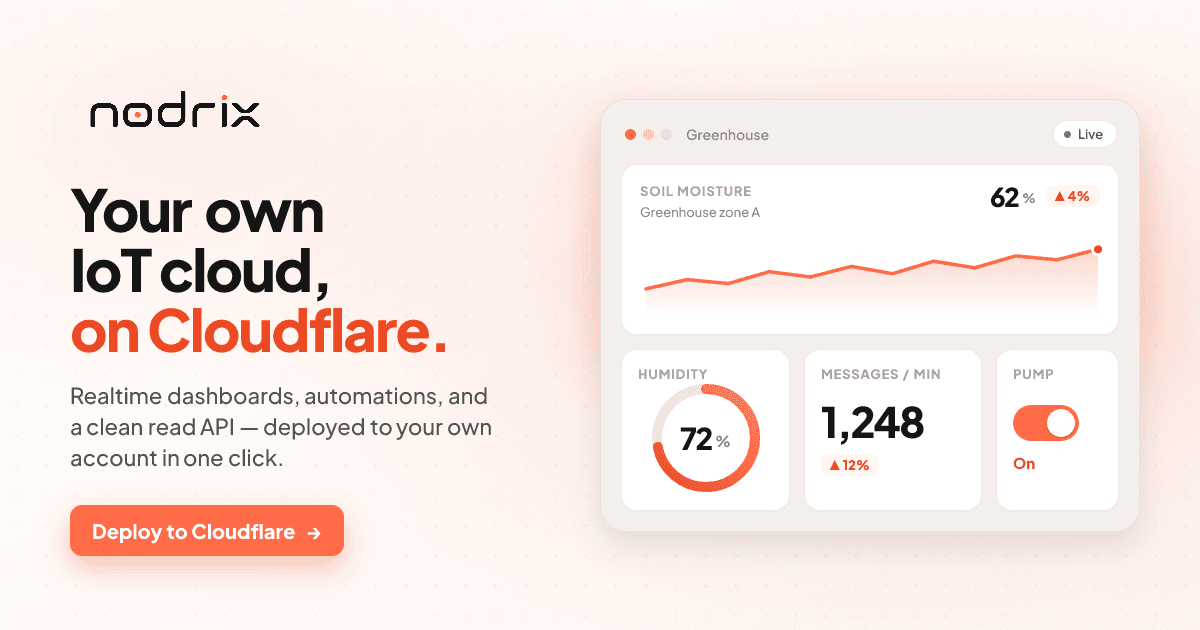
Users drop widgets onto a grid and bind them to variables to see values update live over hibernating WebSockets.
Visual Automations
Flows fire on variable thresholds, a clock, sunrise or sunset, or events, then branch on conditions and set variables, call an integration, or emit an event.
Read API
One bearer token unlocks edge-cached latest state, recent time-series, and variable listings for external apps.
One-Click Deploy
Deploy to Cloudflare provisions D1, R2, KV, and the Worker into your own account as a single-tenant instance.
Widget Library
Framework-agnostic Web Components such as iot-value, iot-gauge, iot-chart, iot-toggle, iot-slider, and iot-push take data in and emit command intents out.
MCP Server
An owner-gated, off-by-default, audit-logged MCP server lets AI clients query projects, read state, and optionally drive automations.
Built-in Accounts
Email and password sign-in works out of the box, with optional Google or GitHub sign-in added on top.
Frequently asked questions about nodrix
Is nodrix free to use?
Yes. The page describes nodrix as free and open source, with a Deploy to Cloudflare button and a GitHub repository you can star. The backend itself costs nothing, and it runs inside your own Cloudflare account.
Do I need an MQTT broker to send data?
No. Hardware speaks plain HTTPS or opens a WebSocket, and variables create themselves the moment a metric arrives, so there is no schema, no MQTT broker, and no SDK to install.
Where does my data live?
Every deployment is single-tenant and lands in your own account, on your own D1 database, R2 storage, and Durable Objects. The page states your data never leaves your account.
How do I deploy nodrix?
Hit Deploy to Cloudflare. The one-click deploy provisions D1, R2, KV, and the Worker straight into your account, leaving nothing to host or maintain yourself.
How do I connect my hardware?
Open the worker URL, create the first account to become the owner, spin up a project, mint a project token, and point the device at /v1/telemetry. Variables show up as soon as data flows.
Can I use nodrix without an SDK?
Yes. Point any client at your worker URL with a project token, send a metric with a JSON POST, and it becomes a variable you can chart, gauge, and control. Read it back over a plain REST call.