
About Mockaroo
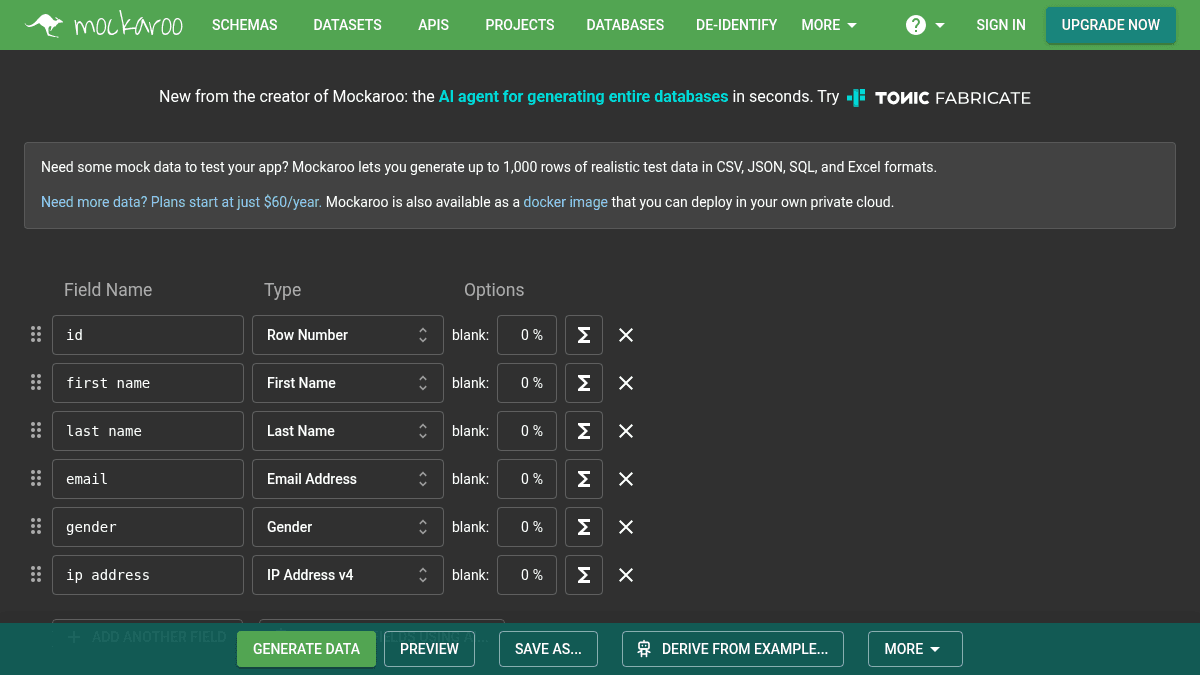
Overview Mockaroo is a test data generator and API mocking tool that creates realistic datasets in CSV, JSON, SQL, Excel, and XML formats. It helps developers and testers simulate production-like data without writing any code. Unlike data mocking libraries that require programming knowledge, Mockaroo works through a web interface where users define field types and download ready-to-use data. It is available as a hosted service or as a Docker image for private cloud deployment. Key Benefits Generate up to 1,000 rows of test data per file on the free plan with no daily download limit from the browser. Create mock APIs with full control over URLs, responses, and error conditions to parallelize front-end and back-end development. Download data in SQL and CSV formats that load directly into test databases without transformation. Access all features on every plan, including AI-powered field generation and custom data types. Automate data generation via a RESTful API using saved schemas and curl scripts after signing in with Google. How It Works You open the schema builder on the web interface, add fields by choosing names and data types like First Name, Email, or IP Address, and set options such as blank percentage. You select the output format (CSV, JSON, SQL, Excel, or XML), choose the number of rows, and click Generate Data to download the file. For mock APIs, you design endpoints with custom responses and error conditions, then point your UI code at the provided mock URLs. Use Cases Front-end developers building UI prototypes that need realistic API responses to uncover flow and timing issues early. QA engineers filling test databases with high-volume, varied data to simulate production conditions and catch edge-case bugs. Data engineers generating sample datasets in SQL or CSV format for pipeline testing and schema validation. Back-end developers testing API endpoints with controlled error conditions and varied payloads before release. Product demo teams preparing realistic-looking data to showcase new features to stakeholders more effectively. Why Choose This Product Mockaroo best suits developers and testers who need realistic test data quickly without learning a programming library or framework. The free tier covers basic needs, while paid plans scale to millions of records. The Enterprise tier adds private cloud hosting via Docker for teams that cannot send data to external services.
Mockaroo Pros & Cons
- Free tier with 1,000 rows per file
- No programming required to generate data
- RESTful API for programmatic access
- Available as a Docker image for self-hosting
- Supports CSV, JSON, SQL, Excel, and XML formats
Key Features
Random Data Generation
Generate up to 1,000 rows of realistic test data for free, with higher limits on paid plans.
Mock API Designer
Design mock APIs where you control URLs, responses, and error conditions to parallelize UI and API development.
Multiple Export Formats
Download generated data in CSV, JSON, SQL, Excel, and XML formats for direct use in test environments.
AI Field Generation
Generate custom data types and fields on any topic using AI directly from the schema builder.
Schema Derivation
Derive a schema automatically from example CSV, JSON, or XML data you already have.
RESTful API Access
Save schemas and download data programmatically using curl and a RESTful URL after signing in with Google.
Docker Deployment
Deploy Mockaroo as a Docker image in your own private cloud or datacenter with the Enterprise plan.
Reusable Functions
Create reusable functions and use formulas like generate(datatype) and bcrypt(str) in your schemas.
Mobile Device Data Types
Generate realistic mobile device data including device types and identifiers.
De-Identification Support
De-identify sensitive production data for safe use in test environments.
Mockaroo Pricing
View full pricing →- 1,000 rows per file
- 200 API requests/day
- 1x speed
- Access to all features
- Hosted on mockaroo.com
- Up to 100,000 rows per file
- Generate 1M records/day via API
- 8x speed
- Access to all features
- Hosted on mockaroo.com
- Up to 10M rows per file
- Generate 10M records/day via API
- 8x speed
- Access to all features
- Hosted on mockaroo.com
- Unlimited data and users for entire company
- Hosted on private cloud or datacenter
- Distributed as Docker image
- Unlimited API calls
- 8x speed or more
| Feature | Free Free/mo | Silver $60/yr | Gold $500/yr | Enterprise Custom/yr |
|---|---|---|---|---|
| 1,000 rows per file | ||||
| 200 API requests/day | ||||
| 1x speed | ||||
| Access to all features | ||||
| Hosted on mockaroo.com | ||||
| Up to 100,000 rows per file | ||||
| Generate 1M records/day via API | ||||
| 8x speed | ||||
| Up to 10M rows per file | ||||
| Generate 10M records/day via API | ||||
| Unlimited data and users for entire company | ||||
| Hosted on private cloud or datacenter | ||||
| Distributed as Docker image | ||||
| Unlimited API calls | ||||
| 8x speed or more |
Pricing extracted from the product website and may change. Check the source for current details.
Frequently asked questions about Mockaroo
How many rows can I generate on the free plan?
The free plan is limited to 1,000 rows per file, with no daily limit on the number of files downloaded from the browser. You also get 200 API requests per day.
Can I automate test data generation?
Yes. After signing in with a Google account, you can save schemas and download data programmatically using curl in a shell script via a RESTful URL.
Is Mockaroo available for private cloud deployment?
Yes. The Enterprise plan includes a Docker image that you can deploy in your own private cloud or datacenter with unlimited data and users.
What formats does Mockaroo support?
Mockaroo supports CSV, JSON, SQL, Excel, and XML formats for downloaded datasets.
Is Mockaroo free?
Mockaroo offers a free plan with optional paid upgrades. See the pricing section for what's included in each tier.
How much does Mockaroo cost?
Mockaroo offers the following plans: Free, Silver, Gold, Enterprise. See the pricing section for what's included in each tier and any per-seat or usage-based costs.