
Axol
Updated: Nov 26, 2026
Configure a dual-arm robot with 860 mm reach and an open-source SDK, then teleoperate it, collect real-world data, train policies, and deploy them in production.
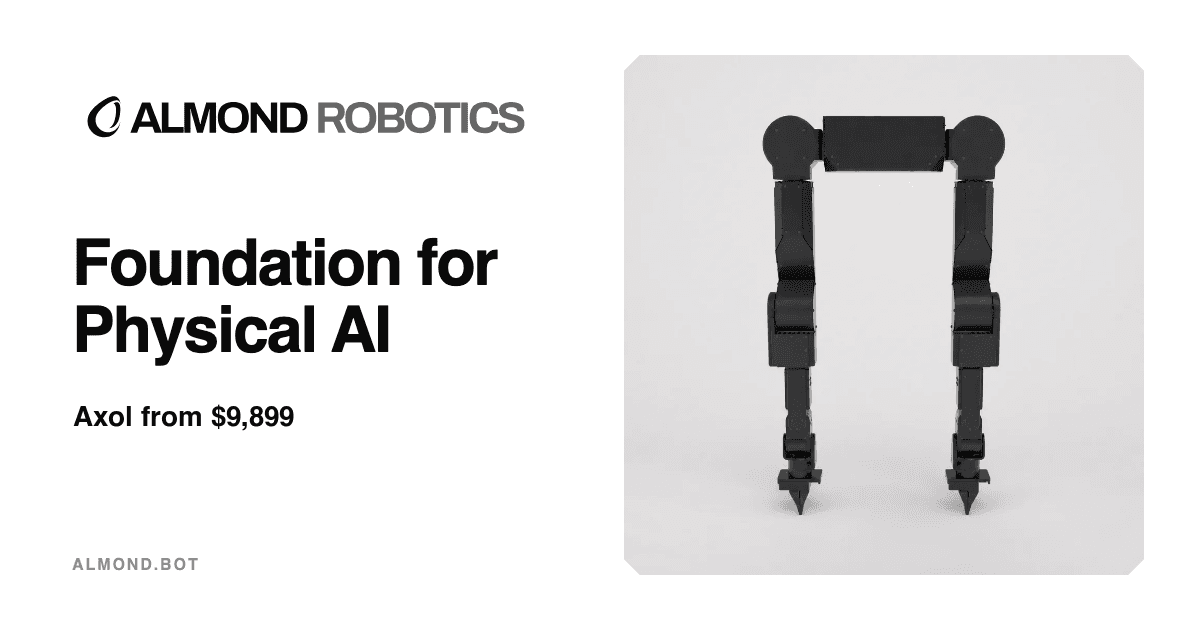
About Axol
Overview
Axol is a configurable dual-arm robot from Almond Robotics, built for teams working on physical AI. Each arm carries seven degrees of freedom, reaches 860 mm, and handles 6.5 kg at peak payload, while the platform closes its control loop at 500 Hz. Almond assembles every unit in its Dogpatch workshop in San Francisco and ships it with the software and hardware needed to start on day one.
Buyers configure mounting, cameras, and compute at checkout, then drive the robot over a single USB-C connection from a Linux machine. The open-source, MIT-licensed Python SDK and CLI cover bimanual inverse kinematics, CAN motor control, ZED camera streaming, LeRobot bindings, and WebXR teleoperation. Almond also sells Mantis UMI, a handheld gripper pair for collecting manipulation data without a robot.
Key Benefits
- Two independent 7-DOF arms reach 860 mm and handle 6.5 kg of peak payload each.
- The Rust realtime core axol-rt runs a 500 Hz control loop over CAN.
- WebXR teleoperation from a Meta Quest streams hand and elbow poses with recording built in.
- An open-source MIT-licensed Python SDK, CLI, and web control panel need no ROS stack.
- Datasets record in LeRobot format so teams replay episodes and run DAgger against a live policy.
- Every Axol ships fully assembled from the San Francisco workshop in about one week.
How It Works
Customers choose a configuration on the site, selecting mounting, cameras, compute, and an optional Quest 3 headset, then order the assembled robot. Axol bolts down through four M8 bolts to a table, the Owl Mount column, the Ox Cart, or the Jelly Mobile powered base. A one-command installer sets up the axol CLI and web control panel on a Linux machine running Python 3.12 or newer, so operators drive the arms from a browser, a terminal, or a VR headset and then record demonstrations and train policies on the same stack.
Use Cases
- Manipulation researchers run contact-rich bimanual experiments on hardware with published CAD, STEP models, and URDFs.
- Robot learning engineers collect demonstrations through VR teleop and train LeRobot policies on the recorded episodes.
- Production teams run trained policies on the robot's Jetson, on a remote server, or in simulation before going live.
- Data collection teams gather real-world bimanual data with Mantis UMI grippers, with no robot required.
- Integrators add mobility by mounting Axol on Jelly Mobile or a height-adjustable Ox Cart lift.
- Universities and labs purchase through invoices, wire transfers, formal quotes, or vendor onboarding paperwork.
Why Choose This Product
Axol competes on reach, payload, and cable routing, offering 860 mm and 6.5 kg per arm against 633 mm and 6 kg for OpenArm, with cables routed internally rather than exposed. Almond publishes the SDK, gripper drawings, STEP models, and sim-ready URDFs, and the same software stack builds, calibrates, and tests every unit in its own factory. Teams needing more can commission mobile base integration, custom mechanical interfaces, arm spec updates, or end effector design, and every customer gets a dedicated Slack channel with the Almond team.
Axol Pros & Cons
- Open-source MIT Python SDK, CLI, and web control panel included
- 860 mm reach and 6.5 kg peak payload per arm
- 500 Hz CAN control loop with a Rust realtime core
- VR teleop from a Meta Quest with recording built in
- Ships fully assembled in about one week
- No official ROS package is shipped today
- Weighs 19.5 kg and needs two people to lift into place
- International orders ship DAP, so duties and VAT fall to the recipient
Key Features
Dual 7-DOF Arms
Two independent 7-DOF arms each reach 860 mm and carry 6.5 kg of peak payload at a 4 kg nominal load.
500 Hz Control Loop
The Rust realtime core axol-rt closes the control loop over CAN at 500 Hz.
WebXR VR Teleop
A Meta Quest or compatible headset drives the arms over Wi-Fi, USB, or the internet via Tailscale with recording built in.
Open-Source SDK
The MIT-licensed Python SDK and CLI expose bimanual IK, a low-level CAN motor interface, ZED camera streaming, and a web control panel without ROS.
LeRobot Data Collection
Teams record episodes, replay them, and run DAgger against a live policy, with datasets stored in LeRobot format.
Tunable Impedance Control
Stiffness and damping adjust per task, and gravity compensation supports hand-guiding the arms.
Camera Passthrough
Each wrist has an internal FAKRA GMSL 2.0 passthrough for machine vision cameras, with ZED wrist and head cameras streaming to the headset over WebRTC.
Modular Mounting
Axol bolts to a table, an Owl Mount column, an Ox Cart, or Jelly Mobile, a powered base with a 610 mm lift.
Sim-Ready URDFs
Published URDFs and meshes let teams test policies in simulation before running them on hardware.
Axol Pricing
Pricing extracted from the product website and may change. Check the source for current details.
Frequently asked questions about Axol
What is Axol?
Axol is a dual-arm robot built for physical AI. It carries two 7-DOF arms with 860 mm reach and 6.5 kg peak payload each, runs at a 500 Hz control rate, and ships deployment-ready out of the box with an open-source Python SDK.
How much does Axol cost?
Axol starts at $9,499 for the complete dual-arm robot with two 2-finger grippers, a 1500 W power supply, and the open-source SDK. Mounting, cameras, compute, and a teleop headset are configurable options. Axol without grippers costs $8,549 for teams bringing their own end effectors.
Do I need an Axol to use Mantis UMI?
No. Mantis UMI is a handheld gripper pair starting at $1,799 that collects bimanual manipulation data anywhere without a robot. Its grippers are geometrically identical to Axol's, so recordings transfer directly to Axol when a team deploys a policy, and the data also trains policies on other robots.
Does Axol work with LeRobot?
Yes. Axol ships with an open-source Python SDK and CLI that includes LeRobot bindings, a bimanual IK solver, a low-level CAN motor interface, ZED camera streaming, and a joint tuning toolkit. Datasets record in LeRobot format, and the docs walk through training with the standard LeRobot pipeline.
How do I teleoperate Axol?
Axol supports WebXR VR teleoperation from a Meta Quest or any compatible headset over Wi-Fi, USB, or the internet via Tailscale. The pipeline streams hand and elbow poses over WebSocket and includes data collection, DAgger correction, and recording modes. A Quest 3 can be added in the configurator.
Is the software open source, and does it support ROS?
The SDK, CLI, web control panel, and VR teleop interface are open source on GitHub under the MIT license. The SDK is Python-first and exposes joint-level control over CAN through an async API that teams can wrap in a ROS 2 node. Almond does not ship an official ROS package today.