
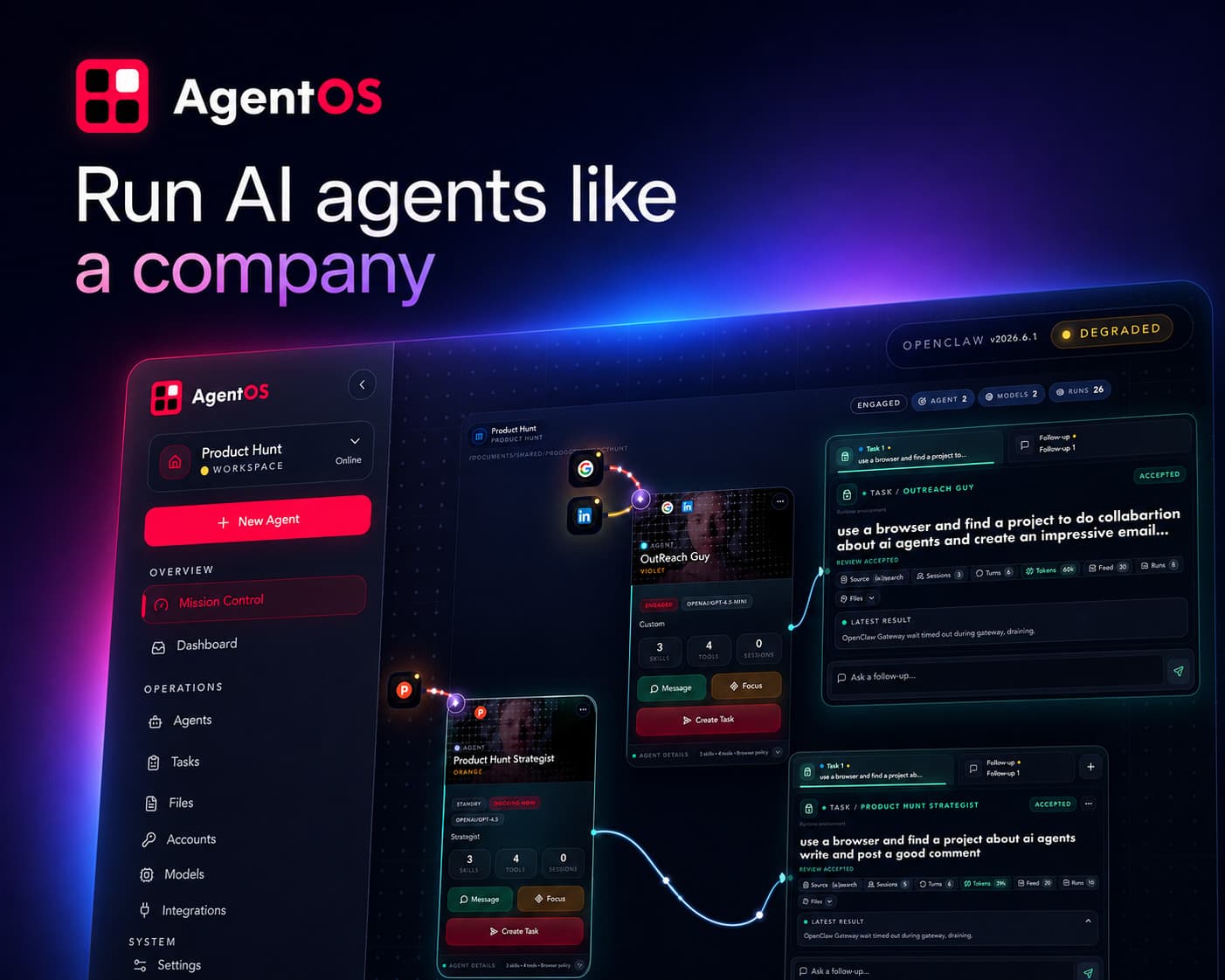
About AgentOS
Overview
AgentOS is a human operating layer built on top of OpenClaw, the agent orchestration kernel. It gives teams one control plane to deploy, manage, and govern a workforce of AI agents across workspaces, tasks, approvals, and runtime visibility.
OpenClaw remains the backend and orchestration layer, covering sessions, tools, and models. AgentOS turns that system into something a team can actually operate: workspaces map to real files and deliverables, agents carry defined skills and worker policies, and operators review consequential actions before they execute.
Key Benefits
- Deploy AgentOS into your own Railway project and keep ownership of the environment your agents run in.
- Hold consequential agent actions at an approval gate so humans review them before execution.
- Inspect live sessions, models, transcripts, presence, and gateway state tied back to the workspace you manage.
- Anchor agent work to real files, folders, docs, memory, and the deliverables a team ships.
- Bundle repeatable operations into jobs that combine task sets, team patterns, and approval rules.
- Start with one proven workflow, such as daily market briefs, campaign launches, or support triage, then extend the team.
How It Works
You begin by defining a workspace: the goal, the operating boundaries, and the human owners. Next you connect agents and give each specialist the tools and knowledge it needs to act inside that workspace. From there the team runs with approvals turned on, so work moves forward while critical actions stay reviewable before they publish, escalate, or ship.
Use Cases
- Solo founders direct research, growth, and support agents across multiple projects from a single control surface.
- AI builders deploy the stack into their own Railway project and retain control of the runtime environment.
- Research teams turn market signals into decision-ready daily briefs with a market intelligence agent.
- Growth teams prepare campaigns and route launch actions to a human for approval before publishing across connected accounts.
- Support operators triage priority tickets and escalate with full context attached to each task.
- Operators and agent-heavy teams coordinate departments of agents with named owners, autonomy levels, and policies.
Why Choose This Product
AgentOS separates orchestration from oversight: OpenClaw stays the runtime truth, and AgentOS supplies the control surface that people actually work in. Because the deployment lives in your Railway project, the environment stays under your ownership. Approval gates, workspace-scoped policies, and runtime visibility reduce silent failure modes rather than hiding them.
AgentOS Pros & Cons
- Deployment lands in your own Railway project, keeping environment ownership in-house
- Approval gates hold critical actions for human review before execution
- Runtime visibility covers sessions, models, transcripts, presence, and gateway state
- Workspaces map agent work to real files, folders, and deliverables
- Clear split between OpenClaw orchestration and the AgentOS control surface
- Requires OpenClaw underneath as the orchestration backend
- Runtime topology depends on how OpenClaw itself is run
Key Features
Workspaces
A workspace holds the files, folders, docs, memory, and deliverables that anchor agent work to a real project.
Configured Agents
Each agent runs as a configured worker with its own skills, tools, and worker policy inside a workspace.
Tasks and Jobs
Tasks scope a unit of work to a workspace and expected output, while jobs bundle repeatable task sets with approval rules.
Approval Layer
AgentOS surfaces critical actions for human review and approval instead of letting the system execute them silently.
Runtime Visibility
Operators inspect live sessions, models, transcripts, presence, and gateway state mapped back to the workspace.
Autonomy Levels
Workspaces carry an autonomy setting such as Guarded, where critical actions require approval before execution.
Railway Deployment
AgentOS launches into your own Railway project so the team retains ownership of the environment.
OpenClaw Kernel
OpenClaw handles orchestration, sessions, tools, and models while AgentOS provides the human control plane above it.
Frequently asked questions about AgentOS
What is AgentOS?
AgentOS is a UI and operating surface for people who run multi-agent work. It helps you manage workspaces, agents, tasks, jobs, teams, approvals, and runtime visibility, while OpenClaw handles the underlying orchestration. The product describes itself as the human operating layer built on top of OpenClaw.
Is AgentOS a replacement for OpenClaw?
No. AgentOS sits above OpenClaw rather than replacing it. OpenClaw remains the runtime truth and orchestration backend, and AgentOS exposes control and visibility as the human operating layer.
Who should use AgentOS?
AgentOS suits anyone coordinating multiple projects or agents who needs a clear control surface, including solo founders, AI builders, operators, agent-heavy teams, and anyone running AI operations with real deliverables.
Does AgentOS run locally?
AgentOS is designed around local-first operations and a workspace that maps to real files and deliverables. The exact runtime topology depends on how you run OpenClaw underneath.
How do I deploy AgentOS?
You launch AgentOS into your own Railway project, which keeps ownership of the environment in your hands. From there you define a workspace, connect agents and context, and run work with approvals switched on.
What does runtime visibility show?
It shows live operational signals such as sessions, models, transcripts, presence, and gateway state, mapped back to the workspace you are managing. Operators use it to spot changes before they become silent failure modes.