
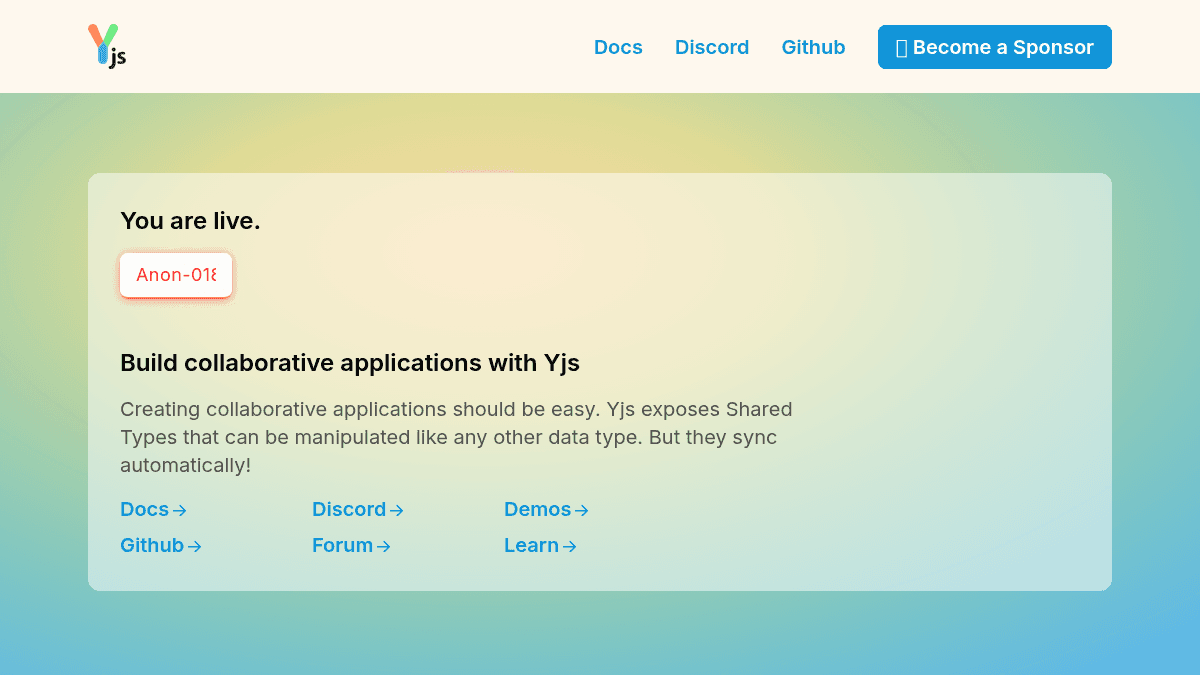
About Yjs
Overview
Yjs is a library for building real-time collaborative multi-user applications. It exposes Shared Types that behave like normal data types but sync automatically across users and devices.
Unlike traditional approaches that require a central server for coordination, Yjs is network agnostic and works with any communication protocol. It is designed for developers building collaborative editors, whiteboards, note-taking apps, and any multi-user tool that needs real-time state synchronization.
Key Benefits
- Shared Types sync automatically across users without manual conflict resolution code.
- Offline support lets users edit locally and sync later when connectivity returns.
- Network agnostic design works without a central server, making systems faster and more fault tolerant.
- Over 900k weekly downloads make Yjs the most popular engine for building collaborative applications.
- Rich ecosystem of integrations with popular editor libraries and web frameworks.
How It Works
You define shared data types (like text, arrays, maps) that behave like normal JavaScript data types. Yjs uses a CRDT (Conflict-free Replicated Data Type) under the hood to automatically merge changes from multiple users without conflicts. You connect users through any transport layer — WebSocket, WebRTC, or Matrix — and Yjs handles the synchronization and conflict resolution.
Use Cases
- Collaborative document editors like Proton Docs, Evernote, and Gitbook use Yjs for real-time co-authoring.
- Project management platforms like ClickUp, Monday, and Shopify rely on Yjs for shared task boards and lists.
- Code editors and IDEs such as Eclipse Theia, Codeanywhere, and JupyterLab integrate Yjs for multi-user coding sessions.
- Note-taking apps including Joplin, Outline, Supernotes, and Affine use Yjs to sync notes across devices and users.
- Whiteboarding and drawing tools like the Yjs Drawing Demo enable real-time collaborative sketching.
- Cloud IDE and machine learning platforms like AWS SageMaker use Yjs for shared notebook environments.
Why Choose This Product
Yjs is best suited for developers who need to add real-time collaboration to web applications without building custom conflict resolution logic. It is open source, network agnostic, and has the largest ecosystem of integrations among collaborative CRDT libraries. The library is maintained by Kevin Jahns and supported by a community forum and Discord server.
Yjs Pros & Cons
- Open source and free to use
- Over 900k weekly downloads
- Network agnostic — no central server required
- Offline-first with local database support
- Rich ecosystem of editor and framework integrations
Key Features
Shared Data Types
Yjs exposes Shared Types like text, arrays, and maps that behave like normal data types but sync automatically across users.
Network Agnostic
Yjs does not require a central server for coordination and can sync through WebSocket, WebRTC, Matrix, or any communication protocol.
Offline Support
Shared data can be stored in a local database like IndexedDB and will be available immediately, syncing later when connectivity returns.
Editor Bindings
Yjs provides ready-to-use integrations with popular editor libraries including ProseMirror, Lexical, and other rich-text editors.
Persistence Layer
Persist shared state in different databases including y-indexeddb, y-leveldb, and y-redis.
Language Bindings
Yjs has been ported to multiple languages including Rust (Yrs), Swift, Python (pycrdt), .NET, Go, and Kotlin.
Awareness CRDT
Implement user awareness features like cursor positions and presence indicators using the built-in Awareness CRDT.
Ecosystem Integrations
Yjs integrates with web frameworks and has a rich ecosystem of services including Y-Sweet, Liveblocks, and Hocuspocus.
Yjs Pricing
Pricing extracted from the product website and may change. Check the source for current details.