About PostCSS
Overview
PostCSS transforms CSS using JavaScript plugins. It lets developers write modern CSS and output cross-browser compatible stylesheets through an extensible plugin system. The tool is built for front-end developers, design teams, and open-source contributors who need automated CSS processing without manual browser workarounds.
Unlike standalone CSS preprocessors, PostCSS works as a post-processor with hundreds of community plugins. It handles vendor prefixing, future CSS polyfills, CSS Modules, and linting in a single pipeline. The project is MIT-licensed and maintained by hundreds of open-source contributors.
Key Benefits
- Autoprefixer adds vendor prefixes based on real-time browser popularity data from Can I Use.
- PostCSS Preset Env converts modern CSS syntax like oklch() into browser-compatible rgb() values.
- CSS Modules scope class names automatically, eliminating name collision in large projects.
- stylelint catches CSS errors such as invalid hex color codes before stylesheets reach production.
- Hundreds of available plugins cover auto-prefixing, future syntax, modules, linting, and more.
How It Works
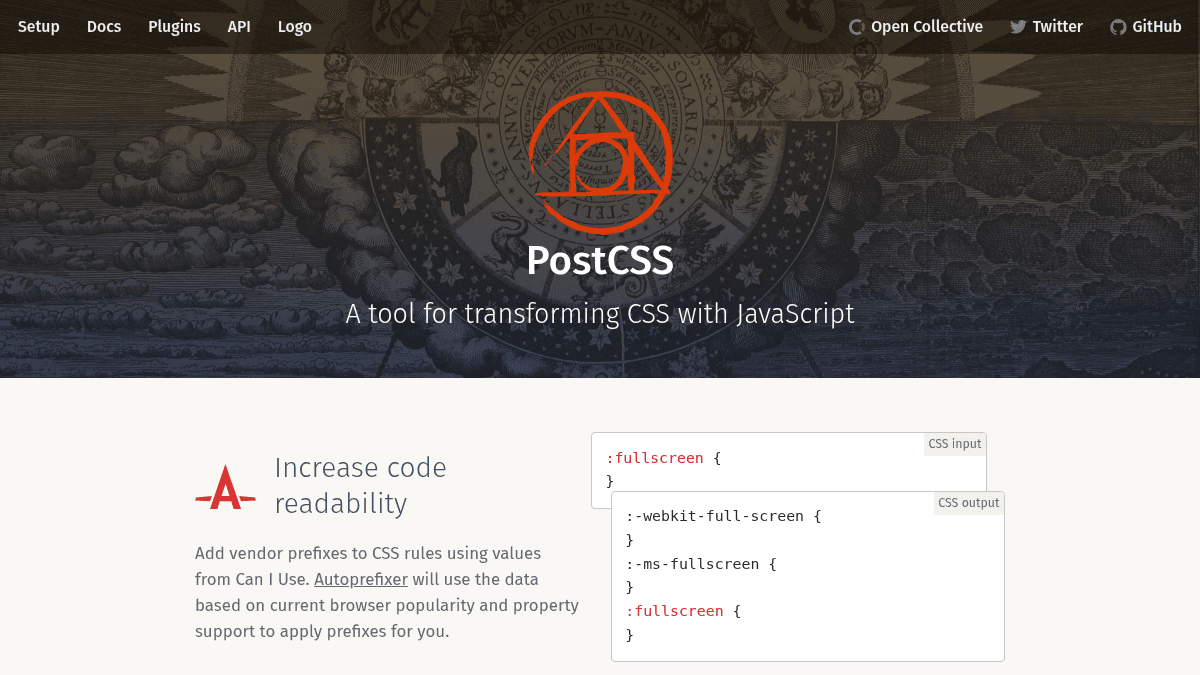
A developer writes standard or experimental CSS in their source files. PostCSS runs the CSS through a configured set of JavaScript plugins during a build step, often integrated via npm and a bundler. Each plugin transforms the CSS — Autoprefixer injects vendor prefixes, Preset Env transpiles future syntax, and CSS Modules generates scoped class names — then outputs standard CSS ready for the browser.
Use Cases
- Front-end developers at agencies who need to support legacy browsers without writing vendor prefixes by hand.
- Open-source library maintainers shipping CSS that must work across multiple browser versions.
- Design system engineers who enforce consistent style rules across a team using stylelint.
- Site reliability engineers automating CSS quality checks in CI pipelines with PostCSS plugins.
- Developers prototyping with future CSS specs like oklch() and relying on Preset Env to polyfill for production.
Why Choose This Product
PostCSS is best suited for developers who want a modular, plugin-driven approach to CSS processing rather than a monolithic preprocessor. The tool is free and open source under the MIT License, supported by a large contributor community. No pricing, hosted service, or paid tier is available — PostCSS is a build-time tool you run locally or in CI.
PostCSS Pros & Cons
- Free and open-source (MIT License)
- Hundreds of available plugins
- Automates vendor prefixing from Can I Use data
- Transpiles future CSS syntax for current browsers
- Supported by a large open-source contributor community
Key Features
Automatic vendor prefixing
Autoprefixer reads Can I Use data to determine which vendor prefixes are needed and applies them automatically.
Future CSS transpilation
PostCSS Preset Env transpiles modern CSS features into browser-compatible syntax using cssdb data.
CSS Modules support
CSS Modules generate unique class names scoped to each component, preventing global style conflicts.
CSS linting with stylelint
stylelint enforces consistent coding conventions and catches invalid CSS like malformed hex colors.
Plugin ecosystem
A plugin-based architecture lets developers choose only the transformations their project needs.
JavaScript-powered transforms
JavaScript-driven transformation pipeline integrates with build tools and bundlers.
Community-driven development
An open-source project with hundreds of contributors, distributed under the MIT License.
PostCSS Pricing
Pricing extracted from the product website and may change. Check the source for current details.
How PostCSS compares
P PostCSSThis | ||
|---|---|---|
| Starting price | Free | Free |
| Pricing model | Free | Free |
| Platforms | Web, macOS, Windows, Linux | Web |
| Top features |
|
|
| Rating | — | — |