About Kiro
Overview
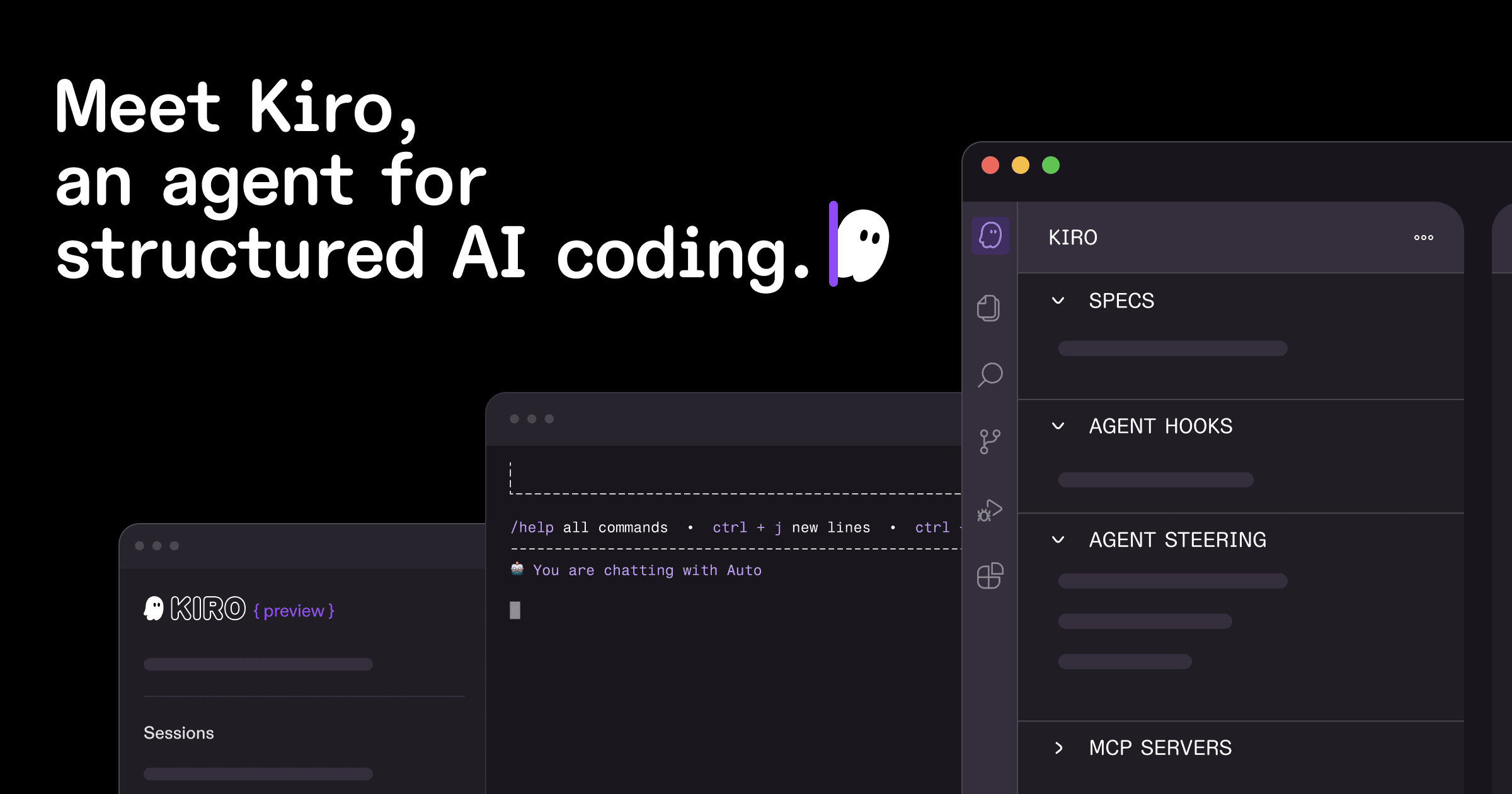
Kiro is an agentic development environment built and operated by AWS. It helps developers and teams turn prompts into executable specs, validate code correctness, and build across large codebases with parallel agents that learn from every session, so what you build matches what you want.
Kiro works alongside developers as an agent in the IDE, with a CLI, in a web browser, from a mobile app, and in Kiro Crew. Agents keep working in the cloud when you step away, and steering files carry across every surface while personal configuration syncs through cloud configuration.
Key Benefits
- Kiro turns a prompt into structured requirements, architectural design, and sequenced tasks before writing any code.
- Property-based tests assert rules that must hold across all inputs, catching edge cases that pass unit tests but break in production.
- Kiro checks requirements for contradictions and gaps using automated reasoning techniques.
- Parallel agents implement tasks on your local machine or in the cloud, and learn from every session.
- The headless CLI runs in CI/CD to review PRs and fix bugs without opening an editor.
- Credit-based pricing carries no daily or weekly rate limits and supports pre-paid overages.
How It Works
Start with a prompt or an existing design. Kiro gathers requirements, checks them for contradictions and gaps using automated reasoning, and produces a system design and discrete tasks. Parallel agents then implement the spec, and property-based tests verify behavior across all inputs. Developers can pull context from tools like Figma or Terraform and run the headless CLI in CI/CD to review PRs.
Use Cases
- Startup CTOs develop business-critical assets in-house and cut time to customer value from weeks to days.
- Principal cloud architects draft Terraform modules for AWS Cloud and AI solutions.
- Security engineers build applications with encryption and security coding practices from shared requirements.
- Data scientists run hooks that generate unit tests and update documentation in the background.
- Open source developers build apps in unfamiliar domains, such as games, without focusing on implementation.
- Enterprise admins manage centralized billing, SSO, usage analytics, and governance across teams.
Why Choose This Product
Kiro is built and operated by a small team within AWS, so it uses the same security, reliability, and privacy standards trusted by millions of customers. It supports open standards including Agent Client Protocol, AGENTS.md, Skills.md, MCP, and Open VSX extensions, and the Kiro CLI works with bash, zsh, fish, and over 500 popular CLIs. Teams get IAM and SSO authentication, usage dashboards, cost management controls, IP indemnity, and governance.
Kiro Pros & Cons
- Free tier includes 50 credits and access to open weight models and Claude Sonnet 4.5
- Built and operated by AWS with enterprise security and governance controls
- Works across IDE, CLI, web interface, mobile app, and Kiro Crew
- Supports open standards including Agent Client Protocol, AGENTS.md, Skills.md, and MCP
- Credit-based pricing with no daily or weekly rate limits and pre-paid overages
- Free tier model access is subject to rate limits
- Feature Specs are not ideal for bug fixes or exploratory coding
- Not all premium models are available in all countries or regions
- Kiro GovCloud pricing is about 20% higher and excludes the Free tier
Key Features
Spec-Driven Development
Kiro turns a prompt into structured requirements, architectural design, and sequenced tasks that agents then implement.
Property-Based Tests
Property-based tests assert rules that must hold across all inputs, catching edge cases that pass unit tests but break in production.
Parallel Agents
Kiro implements specs with parallel agents on your local machine or in the cloud, learning from every session.
Model Choice
Developers pick Anthropic Claude, OpenAI GPT-5.6, open-weight models, or Auto, which selects a model by complexity, quality, latency, and cost.
Agent Hooks
Agent hooks run background tasks such as updating docs, generating unit tests, or optimizing code when predefined triggers fire.
Cloud Sessions
Kiro Web runs sessions in isolated cloud sandboxes that keep going when you close your laptop.
Open Standards
The Kiro agent supports Agent Client Protocol, AGENTS.md, Skills.md, and MCP so you can use it in your favorite tools.
Enterprise Controls
Kiro offers IAM and SSO authentication, usage dashboards, cost management controls, IP indemnity, and governance.
Headless CLI
Run the headless Kiro CLI in CI/CD to review PRs and fix bugs without opening an editor.
Kiro Crew
Kiro Crew is an open-source development workspace that runs on your machine and keeps working across sessions.
Kiro Pricing
View full pricing →- 50 credits
- Access to open weight models and Claude Sonnet 4.5
- Access subject to rate limits
- 1,000 credits
- Access to premium models
- Add-on credits at $0.04 per credit
- 2,000 credits
- Access to premium models
- Add-on credits at $0.04 per credit
- 5,000 credits
- Access to premium models
- Add-on credits at $0.04 per credit
- 10,000 credits
- Access to premium models
- Add-on credits at $0.04 per credit
- Centralized billing
- SSO
- Usage analytics
- Enterprise security controls
- Overages enabled by admins at $0.04 per credit
| Feature | Free Free/mo | Pro $20/mo | Pro+ $40/mo | Pro Max $100/mo | Power $200/mo | Enterprise Custom |
|---|---|---|---|---|---|---|
| 50 credits | ||||||
| Access to open weight models and Claude Sonnet 4.5 | ||||||
| Access subject to rate limits | ||||||
| 1,000 credits | ||||||
| Access to premium models | ||||||
| Add-on credits at $0.04 per credit | ||||||
| 2,000 credits | ||||||
| 5,000 credits | ||||||
| 10,000 credits | ||||||
| Centralized billing | ||||||
| SSO | ||||||
| Usage analytics | ||||||
| Enterprise security controls | ||||||
| Overages enabled by admins at $0.04 per credit |
Pricing extracted from the product website and may change. Check the source for current details.
Frequently asked questions about Kiro
What is Kiro?
Kiro is an agentic AI with an IDE, CLI, web interface, mobile app, and Kiro Crew that helps developers and teams do their best work. It turns prompts into executable specs, validates code correctness to find bugs unit tests miss, and builds across large codebases with parallel agents that learn from every session.
What is spec-driven development and how is it different from vibe coding?
Spec-driven development keeps the fun of vibe coding but fixes some limitations. Vibe coding can require too much guidance on complex tasks or large codebases and can misinterpret context. With specs, Kiro defines requirements, system design, and tasks before writing code, explicitly documenting reasoning and decisions so it implements complex tasks in fewer shots.
How can I get started with Kiro?
Kiro works as an agent in the IDE, with a CLI, in a web browser, from a mobile app, and in Kiro Crew. Download the installer for your operating system, or sign in to use it with a paid account on the web or mobile. Log in with GitHub, Google, AWS Builder ID, or AWS IAM Identity Center; no AWS account is required.
What programming languages does Kiro support?
Kiro supports many languages developers use day to day, including Python, Java, JavaScript, TypeScript, C#, Go, Rust, PHP, Ruby, Kotlin, C, C++, shell scripting, SQL, Scala, JSON, YAML, and HCL.
How does Kiro pricing work?
New users start with the perpetual Kiro Free tier, which includes 50 credits and access to open weight models and Claude Sonnet 4.5 with limits. Paid tiers range from Pro at $20/month, Pro+ at $40/month, Pro Max at $100/month, to Power at $200/month for increased capacity, and paid tiers can buy add-on credits beyond plan limits.
What is a credit?
A credit is a unit of work in response to user prompts. Simple prompts can consume less than 1 credit, while complex prompts such as executing a spec task typically cost more. Different models consume credits at different rates, and credits are metered to the second decimal point, so the least a task can consume is 0.01 credits.