
About Basedash
Overview
Basedash is an AI-native business intelligence platform that turns plain-English questions into governed answers, dashboards, and automated reports on live company data. Founded in 2020 and backed by Y Combinator and Matrix, it powers analytics for more than 5,000 teams worldwide.
The platform bundles self-serve analytics, embedded analytics, a semantic layer, a managed DuckDB warehouse, and ingestion from 750+ data sources into one product. Every answer runs on team-defined metrics and shows the SQL, tables, and definitions behind it, so data leaders can audit a number before anyone shares it.
Key Benefits
- Ask a question in plain English and receive a chart, a dashboard, or a direct answer without writing SQL.
- Trace every result back to the governed definition, SQL, and tables it came from.
- Invite up to 25 users on one flat-rate Startup plan instead of buying a license for each viewer.
- Monitor metrics continuously, with agents that flag anomalies and post the brief to Slack or email.
- Embed white-label dashboards and AI chat in your own product with a few lines of React.
- Govern AI usage centrally with audit logs, SSO and SCIM, row-level permissions, and approval for write queries.
How It Works
Teams connect Postgres, MySQL, Snowflake, BigQuery, Redshift, or Databricks directly, or sync SaaS sources into the managed Basedash Warehouse. They define dimensions, measures, and segments once in the semantic layer, then anyone asks a question in the Basedash chat, in Slack, or through an MCP client such as Claude or Cursor. From there, teams pin results into dashboards, schedule recurring reports and alerts, or embed the same charts inside a customer-facing product.
Use Cases
- Sales operations teams: run revenue and pipeline dashboards for a 15-person org while inviting executives and analysts as viewers on one plan.
- Business users: pull answers from databases, Stripe, and product analytics without filing a ticket with engineering.
- Data teams: publish verified metric definitions once and audit any AI answer against the query it executed.
- Product and SaaS companies: embed white-label analytics and AI chat in their app and scope each customer to its own rows with JWT SSO.
- Security and compliance teams: centralize AI queries under SSO, audit logs streamed to a SIEM, and approval for write queries.
- Founders and executives: receive scheduled AI briefings on metric shifts in Slack or email instead of hunting through dashboards.
Why Choose This Product
Basedash publishes its pricing: a flat-rate Startup tier that covers up to 25 users plus monthly AI credits, and a custom Enterprise tier for self-hosting, embedding, SSO, and larger seat counts. A 14-day free trial with no credit card gives teams full feature access before they commit, and a customer that outgrows 25 users moves to a custom plan rather than adding a per-seat license.
Basedash Pros & Cons
- 14-day free trial with no credit card and full feature access
- Flat-rate Startup plan covers up to 25 users instead of per-seat licensing
- Every AI answer exposes its SQL, tables, and governed definitions
- 750+ data sources sync into a managed warehouse with no pipelines
- SOC 2 Type II plus self-hosting and VPC deployment options
- AI usage beyond the monthly credits is billed as usage fees
- Startup plan stops at 25 users, so larger teams need custom Enterprise pricing
Key Features
AI Data Analyst
Anyone asks a question in plain English and receives a chart, dashboard, or answer computed from governed metric definitions, with the SQL shown for every result.
Prompt-Built Dashboards
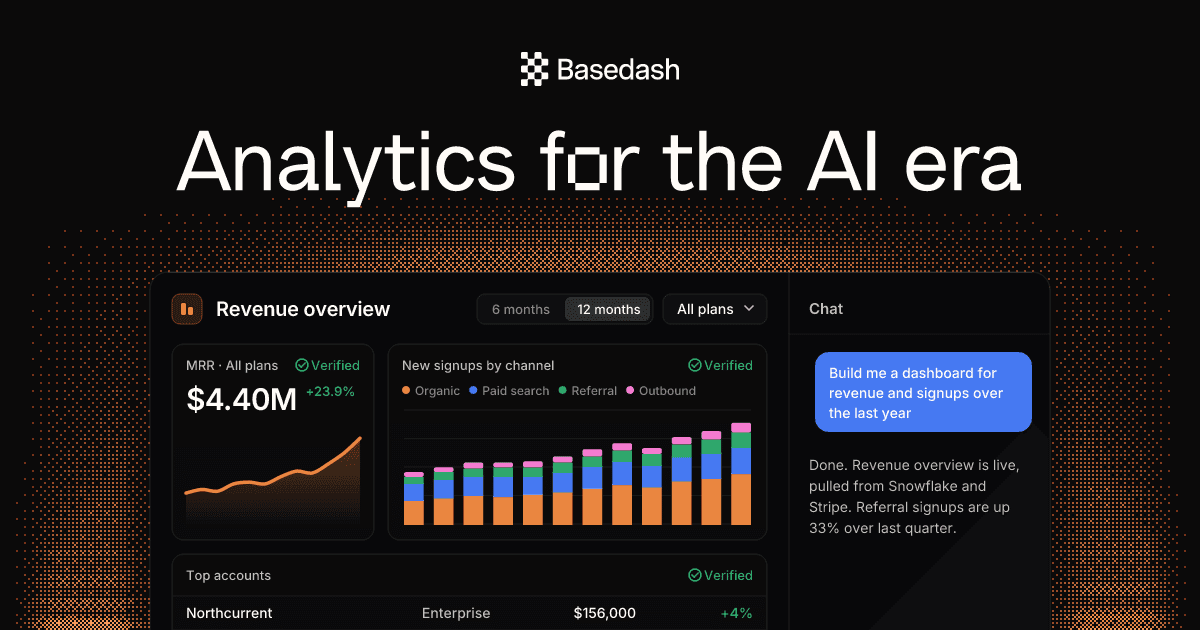
Users describe what they want to track and Basedash builds the dashboard, with each chart connected to live source data at query time.
Proactive Insights
Agents watch metrics around the clock, flag anomalies, explain what moved, and post the brief to Slack or email.
Automations
Teams schedule recurring reports and alerts, or trigger them the moment underlying data changes.
Embedded Analytics
Teams embed dashboards and AI chat in their own product with a few lines of React, white-labeled to their brand and scoped per customer with JWT SSO.
MCP and API Access
Claude, ChatGPT, Cursor, and other MCP clients connect to the same models and permissions, and the REST API lets apps ask questions programmatically.
Semantic Layer
Teams define dimensions, measures, and segments once with verification and version history, or pull in existing dbt projects, and the same definitions power chat, dashboards, and automations.
Managed Warehouse
Connecting a source provisions a managed DuckDB warehouse that keeps tables synced and agent-ready, with storage that scales and point-in-time recovery.
Data Ingestion
Teams authenticate 750+ sources such as Salesforce, HubSpot, Stripe, and Shopify once and Basedash keeps every table fresh without building pipelines.
Governance and Security
Every AI question runs under user permissions and lands in an audit log, backed by SSO and SCIM, row-level security, write-query approval, and SOC 2 Type II.
Basedash Pricing
View full pricing →- Up to 25 users
- $1,000/month in AI credits
- 750+ data sources
- Basedash Warehouse included
- MCP server and Slack app
- Automations and insights
- Custom seat count
- Self-hosting in your own VPC
- Embedding and white-label analytics
- SSO, SCIM, and audit logs
- Custom AI models
- Dedicated support
| Feature | Startup $1000/mo | Enterprise Custom |
|---|---|---|
| Up to 25 users | ||
| $1,000/month in AI credits | ||
| 750+ data sources | ||
| Basedash Warehouse included | ||
| MCP server and Slack app | ||
| Automations and insights | ||
| Custom seat count | ||
| Self-hosting in your own VPC | ||
| Embedding and white-label analytics | ||
| SSO, SCIM, and audit logs | ||
| Custom AI models | ||
| Dedicated support |
Pricing extracted from the product website and may change. Check the source for current details.
Frequently asked questions about Basedash
Is there a free trial?
Yes. Every team can start a 14-day free trial with no credit card required and full feature access. You can connect your data, generate dashboards, and validate how AI-native analytics fits your reporting process before committing.
Does Basedash charge per seat?
Basedash does not charge a separate per-seat fee inside the Startup plan. Startup costs $1,000/month plus AI usage and includes up to 25 users, so teams can invite operators, analysts, executives, and other decision makers without pricing every viewer as a separate license. Enterprise plans are custom for larger deployments.
How does AI usage-based pricing work?
Every plan comes with free monthly AI usage credits. Most AI actions count toward usage, such as asking a question in chat or generating a dashboard. If you exceed the free monthly limit, Basedash charges usage fees on your next bill, and you can track usage in the Billing section of the app.
Can we self-host Basedash?
Yes. Self-hosting is available for teams that need tighter network control, internal infrastructure alignment, or stricter compliance requirements, and organizations can deploy in VPC-based environments as needed.
Do I need SQL to use Basedash?
No. Teams ask business questions in plain English and generate dashboards without writing SQL for every request. The SQL behind each answer is still displayed, so technical users can review and re-run the query for verification.
How does Basedash prevent hallucinations and keep AI analysis accurate?
Basedash translates natural language into structured queries that it validates and executes directly against your connected databases or warehouses. Responses stay grounded in your actual schema, tables, and governed metric definitions, and each generated query can be traced to underlying data and re-run for verification.