
About Authsignal
Overview
Authsignal is a drop-in authentication solution that adds passkeys, adaptive multi-factor authentication (MFA), and passwordless login to any existing app architecture without requiring an identity provider migration. It targets financial institutions, healthcare providers, e-commerce marketplaces, and global airlines that need to balance account security with customer experience.
Unlike building authentication from scratch or replacing an existing identity provider, Authsignal plugs into platforms like Amazon Cognito, Azure AD B2C, Auth0, and Keycloak, delivering risk-based authentication and fraud controls with minimal engineering effort.
Key Benefits
- Authsignal was named a Rising Star in KuppingerCole's 2025 Leadership Compass for Passwordless Authentication, recognising its innovation in passkey and biometric solutions.
- Phishing-resistant passkeys let users authenticate with biometrics such as fingerprint or face recognition, removing the need for passwords entirely.
- The drop-in architecture means teams plug Authsignal into any existing identity provider without migrating users or restructuring their stack.
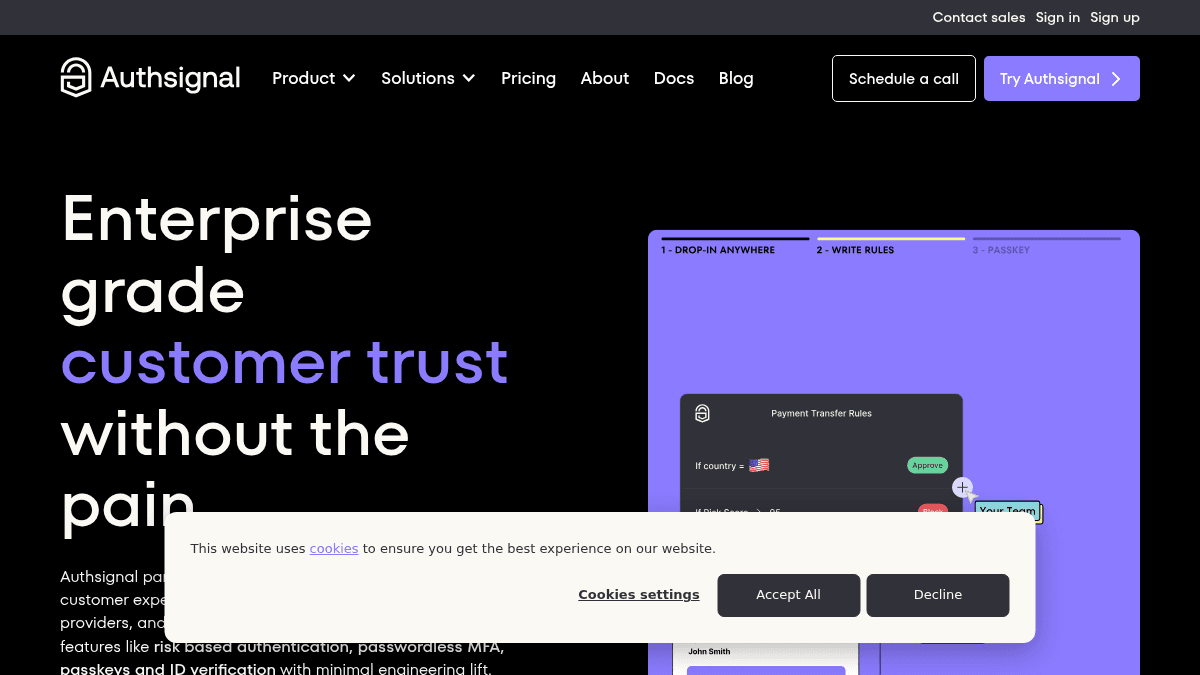
- No-code rule creation lets non-engineering teams build fraud policies and step-up authentication rules without writing code.
- The platform secures millions of passkey transactions hosted out of its Sydney region data centre.
- SMS cost optimisation is a supported use case, allowing teams to reduce outbound OTP SMS spend by shifting to cheaper or free authenticator alternatives.
How It Works
You connect Authsignal to your existing identity provider using one of its integration guides for Amazon Cognito, Auth0, Keycloak, or a custom provider. You then choose an integration mode — pre-built UI, low-code UI components, or a fully custom UI via the API — and configure authenticators such as passkeys, WhatsApp OTP, push notifications, or email magic links. Finally, you define fraud rules and step-up policies through the no-code rules engine, and Authsignal issues JWT access and refresh tokens to keep users signed in across web and mobile.
Use Cases
- Financial services security teams use Authsignal to prevent account takeovers (ATO) with risk-based step-up authentication triggered by suspicious activity.
- E-commerce and marketplace operators adopt passkeys and biometric login to reduce cart abandonment caused by forgotten passwords.
- FinTech and crypto platforms use dynamic linking and step-up MFA to meet regulatory requirements for high-value transaction authorisation.
- Healthcare providers integrate passkey and biometric authentication to protect patient portals while meeting compliance standards.
- Call centre operators reduce inbound support costs by enabling self-service passwordless recovery flows instead of agent-assisted resets.
- Engineers at companies running QR code payment flows use Authsignal's palm biometrics and contactless identity verification to authorise payments at point of sale.
Why Choose This Product
Authsignal suits organisations that already have an identity provider and want to add layered authentication controls — such as passkeys, biometrics, or fraud rules — without a full platform replacement. It is particularly well-suited to regulated industries like financial services and healthcare where step-up authentication and audit trails are mandatory.
Key Features
Passkey Authentication
Authsignal supports phishing-resistant passkeys that let users authenticate via biometrics such as fingerprint or face recognition instead of passwords.
Risk-Based Authentication
A rules and policies engine evaluates risk signals at runtime and triggers step-up authentication challenges when suspicious activity is detected.
Multi-Channel OTP
Authsignal supports SMS OTP, WhatsApp OTP, email OTP, magic links, push notifications, and authenticator apps (TOTP) as authentication methods.
Palm Biometrics
Authsignal integrates palm biometric authentication for contactless payments and in-person identity verification at point of sale.
Flexible Integration Modes
Teams can deploy Authsignal using a pre-built UI, low-code UI components, or a fully custom UI built against the Digital Credentials API (currently in beta).
Identity Provider Plug-In
Authsignal connects directly to existing identity providers including Amazon Cognito, Azure AD B2C, Auth0, Keycloak, Duende IdentityServer, and NextAuth.js without requiring migration.
No-Code Rule Creation
Non-technical teams can build fraud detection policies and step-up authentication rules using a no-code rule creation interface.
Session Management
Authsignal issues JWT access and refresh tokens to keep users signed in across web and mobile after authentication.
User Observability & Audit Trails
The platform records risk alerts, user activity, and audit trails to give security teams full visibility into authentication events.
Digital Credentials API
A beta API allows customers to authenticate instantly using digital credentials, enabling identity verification without traditional credential entry.
Authsignal Pricing
Pricing extracted from the product website and may change. Check the source for current details.
How Authsignal compares
AuthsignalThis | ||
|---|---|---|
| Starting price | — | Free |
| Pricing model | Freemium | Freemium |
| Platforms | Web, iOS, Android | Web |
| Top features |
|
|
| Rating | — | — |
